
Unifying CPU core type processing between Intel and AMD, and significant optimisations for gaming performance on older hardware
 By Frank Ulom
·
Published on August 22, 2026
·
4 min read
By Frank Ulom
·
Published on August 22, 2026
·
4 min read
The merge window for Linux kernel version 7.3 officially opened on August 17. During the first development week, the x86 architecture and scheduler received several important updates, including preparation for AMD’s upcoming low-power cores, unifying CPU core type processing between Intel and AMD, and significant optimisations for gaming performance on older hardware.
For example, the Linux 7.3 kernel incorporates support for AMD’s new “low-power” CPU core types, unifies the processing of different CPU core types from Intel and AMD, and adds several scheduler improvements for gaming performance, hybrid architecture processors, and scheduling latency.
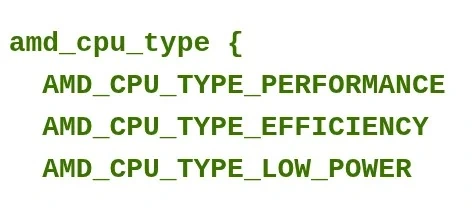
The x86/CPU related code in Linux 7.3 has been merged, and a new type, AMD_CPU_TYPE_LOW_POWER, has been added to identify AMD’s upcoming low-power CPU cores. Previously, Linux could only classify these unidentified cores as “unknown”.
In addition to adding the new AMD core type, Linux 7.3 also unified the handling mechanism for CPU core types. Previously, Intel and AMD used their own proprietary core type numbers. Linux will now map these vendor-specific types to a general-purpose CPU core type, thereby reducing processing differences between different vendors.
This adjustment is related to a code issue previously discovered by the Sashiko AI bot. The bot noticed differences in core type numbers among different CPU manufacturers, which could easily cause confusion in code understanding and processing. Therefore, related development work further promoted the establishment of a universal core type mechanism.
The x86/core portion of Linux 7.3 also incorporates an optimisation for older AMD processors. For AMD Athlon XP-era processors that support SSE but not SSE2, the kernel can now use the SFENCE instruction when writing memory barrier code.
Daily Lamp noted that the relevant code also includes a KCFI optimisation, which can improve related processing on older Intel processors. KCFI stands for Kernel Control-Flow Integrity, used to limit abnormal modifications to the kernel control flow.
Linux 7.3 also made adjustments to the MSR (Model-Specific Register) interface. The kernel will stop using the 32-bit MSR interface and instead adopt a unified 64-bit interface to further simplify code. The 32-bit MSR interface is expected to be officially removed during the Linux 7.4 development cycle.
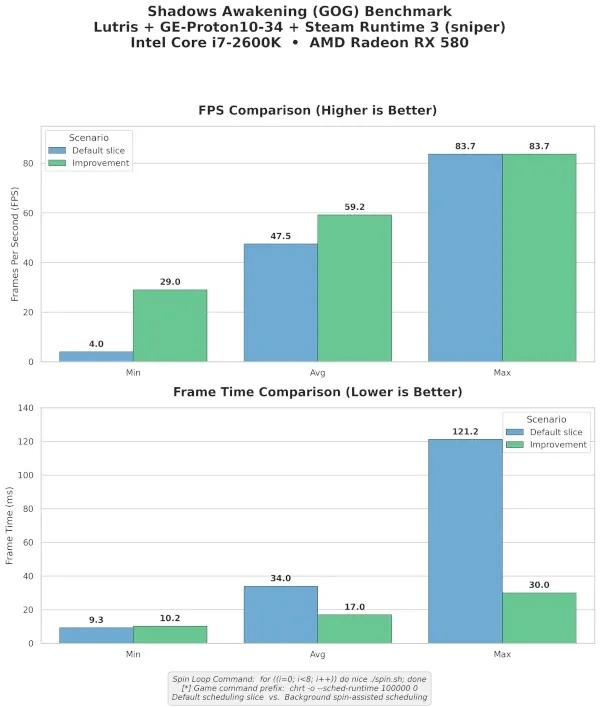
Regarding the scheduler, Linux 7.3 also incorporated several improvements. One key focus was on improving gaming performance on older hardware by adjusting the cgroup scheduling mechanism to enhance processor task scheduling.
This patch was developed by Intel engineer Peter Zijlstra, and the test platform used an Intel Sandy Bridge processor paired with an AMD Radeon RX 580 graphics card. The developers improved task weight allocation and run queue handling by adjusting the cgroup scheduling mechanism.
This work, known as “flatten the pick,” aims to address long-standing scheduling behaviour issues in cgroup scheduling, including improper handling of renice tasks. The new mechanism provides cgroup weight allocation modes such as up, max, concur, and tasks, with the concur mode used by default for more precise weight allocation, but this also incurs higher processing overhead.
The changes also adjust cgroup scheduling to a single run queue. Test results released by the developers show that this mechanism provides some performance improvement in game scenarios on older hardware platforms.
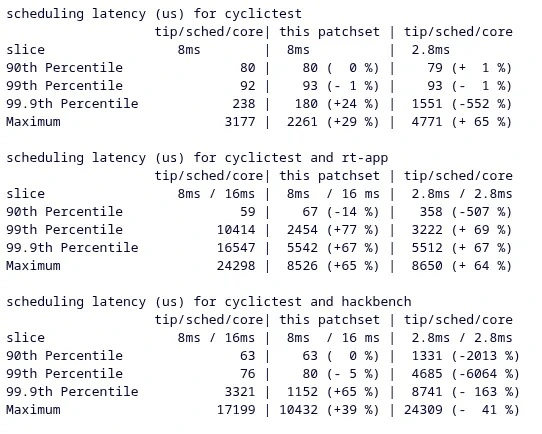
The Linux 7.3 scheduler also reduces scheduling latency for short-time-slice tasks. Developer Vincent Guittot’s published cyclictest results show that these changes significantly improve some scheduling latency metrics.
For Intel hybrid architecture processors, Linux 7.3 also fixes a significant issue in cluster scheduling. Due to the performance difference between P-cores and E-cores, the system needs to account for asymmetric computing power between CPU cores. This update further improves cluster load balancing on these processors.
Furthermore, during NOHZ load balancing, Linux 7.3 now prioritises fully idle CPU cores for load balancing to further improve task allocation. The NOHZ mechanism allows idle CPUs to reduce periodic clock interrupts, thereby reducing unnecessary power consumption and processing overhead.
