
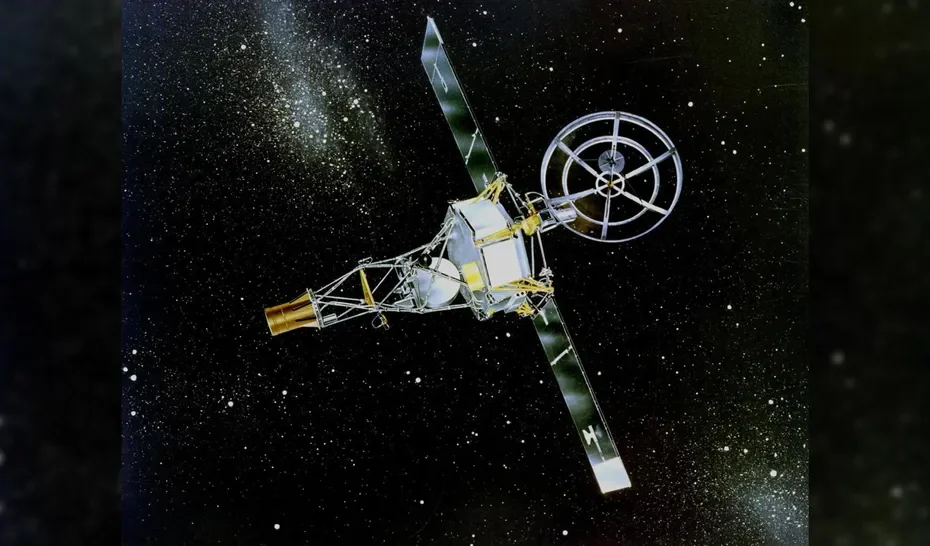
The landmark manoeuvre came just eight days after Mariner 2 launched from Earth on August 27, 1962, aboard an Atlas-Agena rocket.
 By Frank Ulom
·
Published on September 4, 2026
·
4 min read
By Frank Ulom
·
Published on September 4, 2026
·
4 min read
NASA’s Mariner 2 spacecraft made history on September 4, 1962, by performing the first successful rocket-powered manoeuvre in deep space as it corrected its trajectory towards Venus.
The landmark manoeuvre came just eight days after Mariner 2 launched from Earth on August 27, 1962, aboard an Atlas-Agena rocket.
The launch vehicle did not place the spacecraft on an accurate enough trajectory to reach Venus directly, forcing mission controllers to develop an unprecedented solution.
About 1.5 million miles (2.4 million kilometres) from Earth, Mariner 2 fired its onboard engine to alter its course and ensure that it would reach its target.
The manoeuvre required five separate commands from mission control, instructing the spacecraft to roll, pitch, turn and fire its rocket engine.
The entire process took up to 36 minutes.
According to accounts of the mission, Mariner 2 first rolled approximately 9.33 degrees before pitching its nose by about 139.83 degrees. This positioned its rocket engine to fire in the required direction and change its trajectory.
The correction was critical.
Without it, Mariner 2 would have passed about 238,600 miles (384,000 kilometres) from Venus’s centre and missed the planet entirely.
Following the manoeuvre, the spacecraft was placed on a trajectory that would take it approximately 21,607 miles (34,773 kilometres) from Venus.
One hundred days after the course correction, Mariner 2 successfully flew past Venus, becoming the first spacecraft to successfully encounter another planet.
A risky breakthrough in early space exploration
Today, mid-course corrections are a routine feature of interplanetary missions, but the technique represented a major technological challenge in 1962.
At the time, sending a spacecraft to another planet remained a largely untested undertaking. Mission planners had to control a spacecraft millions of kilometres from Earth and make precise adjustments using commands transmitted from the ground.
The success of Mariner 2 demonstrated that spacecraft could be navigated and redirected after leaving Earth’s immediate vicinity.
The achievement became an important milestone in the development of interplanetary exploration.
Since then, increasingly sophisticated navigation techniques have enabled spacecraft to undertake complex journeys through the Solar System.
One of the most important developments has been the use of gravity assists, in which spacecraft fly close to planets and use their gravitational fields to alter their speed and trajectory.
NASA’s Voyager 2, for example, used a series of planetary encounters to undertake its historic journey past Jupiter, Saturn, Uranus and Neptune.
The legacy of Mariner 2
Mariner 2’s achievement was more than simply a successful correction of its flight path. It demonstrated that a spacecraft could be deliberately manoeuvred after launch to overcome inaccuracies and reach a distant planetary target.
The spacecraft subsequently collected important scientific data during its Venus encounter, helping scientists learn more about the planet’s atmosphere and environment.
More than six decades later, the basic principle pioneered by Mariner 2 remains fundamental to planetary exploration.
Modern spacecraft routinely perform trajectory corrections, although the manoeuvres remain crucial moments in missions where a small navigational error can determine whether a spacecraft reaches its destination or misses it by hundreds of thousands of kilometres.
A striking example came on September 3, 2026, when the European Space Agency and Japan Aerospace Exploration Agency’s BepiColombo mission carried out another major milestone on its long journey to Mercury.
The mission’s Mercury Transfer Module released its two spacecraft, one operated by Europe and the other by Japan, as they moved into the next phase of their arrival at Mercury.
BepiColombo launched in 2018 and has relied on a complex sequence of trajectory adjustments and planetary flybys, including nine encounters with planets, to reach its destination.
The contrast highlights how far spacecraft navigation has advanced since Mariner 2.
In 1962, a single mid-course correction was an extraordinary demonstration of emerging space technology. Today, such manoeuvres form an essential part of missions involving some of the most distant and complex destinations in the Solar System.
Mariner 2’s September 4, 1962 manoeuvre therefore stands as a foundational moment in the history of deep-space navigation — when engineers demonstrated that a spacecraft could not only leave Earth, but also change its course millions of kilometres away to reach another world.
