
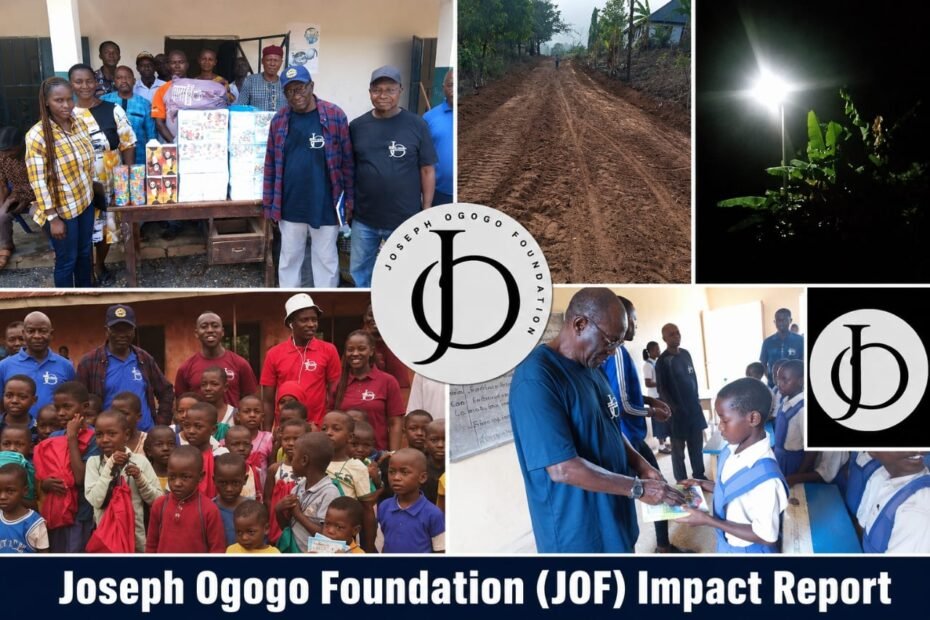
The Foundation’s interventions have focused particularly on vulnerable children and underserved rural communities, with programmes spanning educational support, tuition relief, solar-powered street lighting, road connectivity and efforts to improve digital access
 By Frank Ulom
·
Published on August 20, 2026
·
7 min read
By Frank Ulom
·
Published on August 20, 2026
·
7 min read
The Joseph Ogogo Foundation (JOF) has expanded its humanitarian interventions across Obanliku Local Government Area of Cross River State, moving beyond immediate relief to support education, community safety, infrastructure and long-term development.
The Foundation’s interventions have focused particularly on vulnerable children and underserved rural communities, with programmes spanning educational support, tuition relief, solar-powered street lighting, road connectivity and efforts to improve digital access.
At the centre of JOF’s approach is the belief that addressing poverty and educational barriers requires more than short-term assistance.
The Foundation maintains that a child’s ability to learn is affected by several factors, including access to school fees, uniforms and learning materials, as well as the safety and infrastructure of the community in which the child lives.
Educational support begins at Bukemanya
JOF’s First Intervention Programme targeted one of the immediate challenges facing rural families — the cost of keeping children in school.
The programme was launched at Bukemanya Government Primary School and 10 other schools, providing educational assistance to children whose families struggled to meet the cost of school fees, exercise books, writing materials and other basic requirements.
The intervention was aimed at preventing financial hardship from forcing children out of school or leaving them without the materials needed to participate effectively in classroom activities.
According to the Foundation, the programme also contributed to renewed interest in education, improved attendance and greater confidence among pupils and their parents.
However, JOF said the first intervention was designed as the beginning of a continuing commitment rather than a one-off humanitarian exercise.
Second intervention targets dignity and tuition burden
The Foundation subsequently expanded its support through its Second Intervention Programme, which addressed additional needs affecting pupils and their families.
The programme provided school uniforms, exercise books, writing materials and other essential educational resources.
A major component was the full payment of school tuition fees for primary and pre-primary pupils at Bukemanya Government Primary School.
The Foundation said the intervention was intended to remove a major financial burden from parents and guardians while helping children remain in school without the threat of withdrawal over unpaid fees.
JOF also identified dignity as an important part of educational participation.
By providing pupils with uniforms and learning materials, the Foundation sought to reduce the stigma associated with poverty and give children greater confidence to participate alongside their classmates.
Third intervention extends support to remote communities
The Third Intervention Programme consolidated the Foundation’s previous educational support while extending assistance to more communities across Obanliku.
JOF renewed educational assistance for pupils who had previously benefited from its programmes, reflecting its stated commitment to continuity.
The Foundation said maintaining children in school was as important as getting them into the classroom in the first place.
The third phase also reached schools located in communities with limited access by motorable roads.
Educational materials were transported to the affected communities, with feedback confirming that the materials reached the intended pupils.
The Foundation said the experience reinforced its determination to ensure that geographical isolation did not become a permanent barrier to educational opportunities.
Community dialogue forms part of intervention strategy
JOF has also incorporated engagement with local stakeholders into its intervention programmes.
The Foundation has held discussions with traditional and community leaders, teachers, elders and other stakeholders to understand emerging needs and establish channels for feedback.
The approach allows the Foundation to identify specific community challenges and design interventions around local realities rather than relying solely on predetermined solutions.
Solar street lights target community safety
JOF’s intervention has expanded beyond education to public infrastructure, including the installation of solar-powered street lights along key highways and major community routes.
The project is intended to improve visibility, enhance movement at night and contribute to safer environments for residents.
The solar-powered installations also provide an alternative in communities where conventional electricity supply remains unreliable or unavailable.
For the Foundation, improved community safety forms part of the wider environment required for children and families to thrive.
Roads identified as key to rural development
Road connectivity is another area identified by JOF as critical to sustainable development in rural communities.
Poor road networks can restrict access to schools, health facilities and markets, while also making it difficult for farmers to transport agricultural produce and for emergency services to reach residents.
The Foundation has therefore supported local road maintenance initiatives and advocated improvements to important routes linking communities.
Communities including Bukemanya and Ketting Bendi have received particular attention as part of efforts to improve mobility and strengthen connections with neighbouring communities and urban centres.
Foundation seeks to bridge digital divide
JOF has also recognised digital connectivity as an increasingly important component of community development.
The Foundation said reliable network access could expand opportunities in education, entrepreneurship, financial inclusion, communication and access to information.
Its efforts to improve connectivity in underserved communities are aimed at creating the conditions for greater digital inclusion and participation in the wider economy.
From humanitarian relief to sustainable development
The Foundation’s interventions demonstrate an evolving approach to humanitarian service, moving from immediate educational assistance towards a broader community-development model.
What began with the question of how vulnerable children could remain in school has expanded into a wider effort to improve the conditions in which children and families live.
The Foundation’s interventions now cover school fees, uniforms and learning materials, as well as public safety, roads, mobility and digital connectivity.
JOF said its objective is to address immediate needs while creating conditions that can support long-term self-reliance.
Faith and community service
Another major component of the Joseph Ogogo Foundation’s work is its faith-based commitment to service.
The Foundation undertook the construction of St. Justine’s Catholic Church, building the worship centre from the ground up before handing it over to the Catholic Church community.
The project represents one of the Foundation’s major expressions of faith and community service.
The church has been described as one of the notable worship centres within the Catholic Diocese of Ogoja, with its construction adding a permanent community asset to the Foundation’s portfolio of interventions.
Beyond the physical structure, the project provides a place for worship, fellowship and the transmission of spiritual values across generations.
A broader model of philanthropy
Through the Joseph Ogogo Foundation, founder Joseph Ogogo has extended his philanthropic activities from individual assistance to broader community-development initiatives.
The Foundation’s interventions have sought to support vulnerable children, strengthen rural communities and provide infrastructure capable of serving residents beyond the period of the initial intervention.
Its activities include educational assistance, tuition support, learning materials, solar street lighting, road-related initiatives, digital connectivity efforts, humanitarian support and the construction of a church.
The Foundation’s philosophy is centred on using available resources to improve lives, strengthen communities and serve humanity.
Building a lasting legacy
The Joseph Ogogo Foundation’s activities in Obanliku represent more than a collection of completed projects.
Each educational intervention is intended to remove a barrier to learning, while each infrastructure project seeks to address a wider condition affecting community life.
The Foundation believes that the impact of philanthropy should be measured not only by the resources provided but also by the opportunities created and the lives affected.
From rural pupils receiving school materials and tuition support to communities gaining improved lighting, mobility and connectivity, JOF’s interventions reflect an attempt to link humanitarian assistance with sustainable development.
The construction of St. Justine’s Catholic Church further adds a lasting spiritual and physical asset to the Foundation’s legacy.
As it continues its work, the Joseph Ogogo Foundation says it remains committed to transforming communities, restoring hope, empowering generations and serving humanity to the glory of God.
Joseph Ogogo Foundation — transforming communities, restoring hope and empowering generations.
