
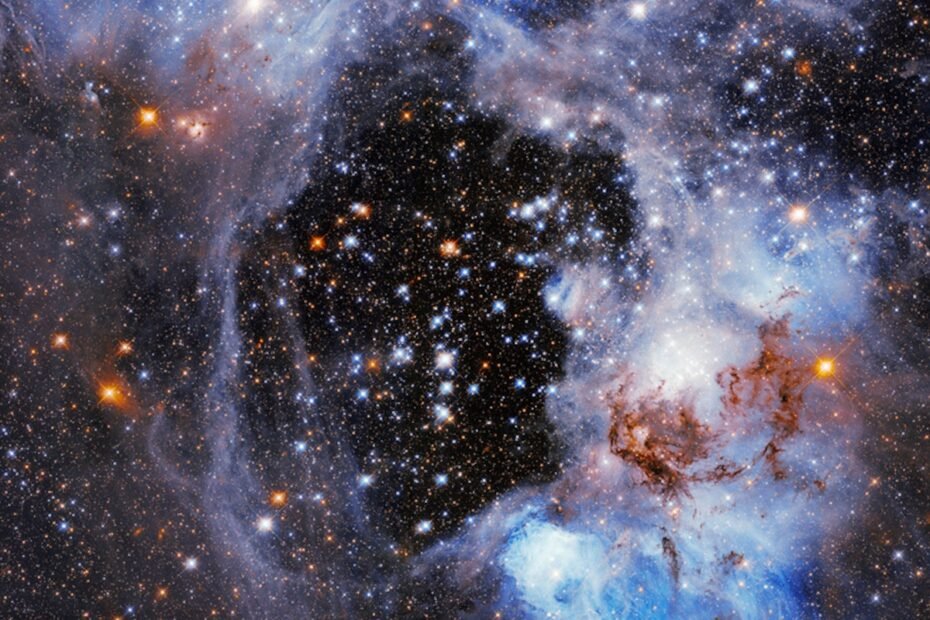
The feature, known as LHA 120-N44 or simply N44, contains glowing hydrogen gas, dark dust lanes, massive stars and stellar populations of different ages.
 By Frank Ulom
·
Published on September 4, 2026
·
4 min read
By Frank Ulom
·
Published on September 4, 2026
·
4 min read
NASA and the European Space Agency (ESA) have released a striking Hubble Space Telescope image showing a huge stellar “superbubble” carved into a colourful nebula in the Dorado constellation.
The feature, known as LHA 120-N44 or simply N44, contains glowing hydrogen gas, dark dust lanes, massive stars and stellar populations of different ages.
N44 lies within the Large Magellanic Cloud (LMC), the largest of the small galaxies orbiting the Milky Way. The galaxy is located about 160,000 light-years from Earth.
At the heart of the nebula is a vast cavity measuring approximately 210 by 140 light-years. NASA and ESA scientists believe the enormous void was created by the powerful activity of stars concentrated at its centre.
N44 itself stretches roughly 1,000 light-years and is considered a highly active region of star formation.
Stars carved out the giant cavity
The central stars are believed to have cleared much of the gas surrounding them through powerful stellar winds and explosive supernovae.
These violent processes pushed the material outward, compressing the displaced gas into a dense, dusty shell around the cavity.
That shell forms the colourful perimeter surrounding the dark central region visible in the Hubble image.
The process is still occurring. New stars are continuing to form within the compressed gas, giving astronomers an opportunity to study how stellar nurseries develop and evolve.
Researchers are particularly interested in determining how much time passes between the collapse of cold clouds of gas into dense clumps and the moment nuclear fusion begins inside newly formed stars.
NASA has previously identified a possible age difference of about five million years between stars located within the superbubble and those found around its rim.
One region is among N44’s hottest
The deep-blue region at the lower right of the superbubble is one of the hottest parts of N44 and contains some of the nebula’s most intense star formation.
N44 is classified as an emission nebula because radiation from nearby stars energises, or ionises, its gas, causing it to glow.
Another smaller bubble can be seen towards the upper right of the Hubble image.
Known as N44F, the feature is an interstellar bubble produced by the intense stellar winds of a single hot, massive star.
Together, the structures provide scientists with a natural laboratory for examining how massive stars reshape their surroundings.
Hubble census reveals hundreds of thousands of stars
The new image is based on research in which Hubble was used to conduct a census of stars in N44.
Astronomers have catalogued approximately 500,000 stars in the region, including about 30,000 classified as “pre-main-sequence stars”.
These young stars have not yet begun fusing hydrogen into helium in their cores, making them particularly valuable for studying the earliest stages of stellar evolution.
The observations are part of wider efforts to understand how massive stars influence the formation of subsequent generations of stars.
As massive stars release energy and material into their surroundings, they can both destroy existing clouds of gas and compress other clouds enough to trigger new episodes of star formation.
N44 therefore offers astronomers a rare opportunity to observe these competing processes within the same cosmic environment.
A window into stellar evolution
The latest Hubble observations add to a growing body of research into the birth and evolution of stars.
NASA recently launched the Nancy Grace Roman Space Telescope, designed to investigate the Universe across wide areas of the sky and complement observations made by Hubble and the James Webb Space Telescope.
Webb has also been used to investigate some of the earliest and most extreme objects in the Universe, including evidence about the formation of supermassive black holes.
Hubble, meanwhile, continues to provide detailed observations of stellar nurseries, including images of very young “infant stars” captured as part of the Sofia Massive Star Formation Survey.
The N44 superbubble provides another example of the telescope’s ability to reveal the complex environments in which stars are born, evolve and ultimately reshape the galaxies around them.
