
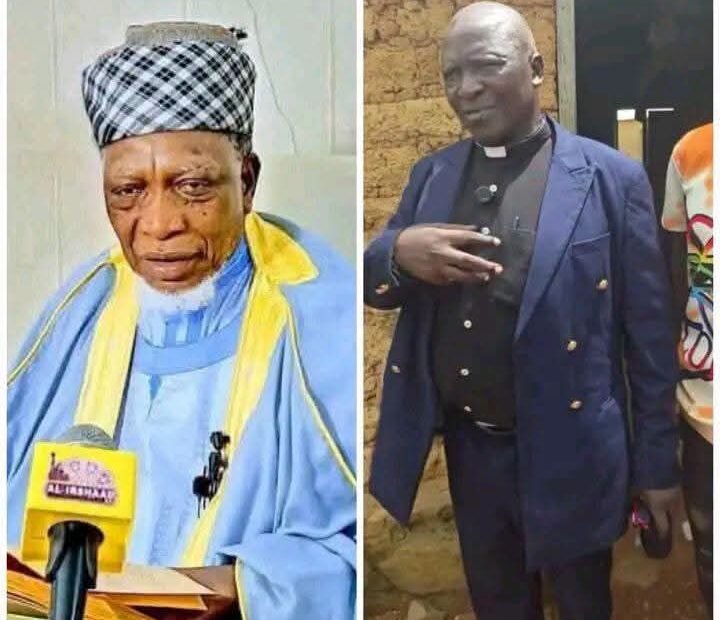
I have absolutely no problem condemning Rev. Dachomo where I believe he is wrong
 By Solomon Dalung
·
Published on August 10, 2026
·
6 min read
By Solomon Dalung
·
Published on August 10, 2026
·
6 min read
By Solomon Dalung
I have been seeing people asking me to condemn Rev. Ezekiel Dachomo the same way I condemned Sheikh Sani Yahaya Jingir, with some even describing Dachomo as the Christian version of Jingir.
Fair enough.
But if we are going to have that conversation, then let us have it honestly and without reducing everything to “your cleric versus my cleric.”
I have absolutely no problem condemning Rev. Dachomo where I believe he is wrong. In fact, I would consider it hypocritical to condemn a Muslim cleric for inflammatory religious rhetoric and then suddenly become defensive when a Christian cleric does something similar.
My standard cannot depend on the religion of the person speaking.
But I also don’t think we should pretend that Jingir and Dachomo have said exactly the same things, or that they are speaking from exactly the same circumstances.
That distinction matters.
Rev. Dachomo has witnessed some of the most horrifying consequences of the violence that has ravaged Christian communities in Plateau and elsewhere. He has buried victims. He has spoken from the pain, anger and fear of communities that feel abandoned and repeatedly attacked.
That reality must not be minimised.
Christians have every right to demand protection. They have every right to speak angrily about people being killed in their communities. They have every right to question government when they believe it has failed them.
But legitimate pain does not give anybody a licence to demonise another religion.
When Rev. Dachomo referred to Allah in extremely derogatory terms and connected the invocation of “Allahu Akbar” with the killing of Christians, I believe he crossed a line. That language does not merely condemn terrorists. It can easily be heard as an attack on the faith itself and on millions of ordinary Muslims who have nothing whatsoever to do with the violence.
The same applies to describing a Muslim-Muslim presidency as “complete genocide to Christians” or portraying it as an “Islamic agenda.” Those are very serious claims, and I believe they deserve to be challenged.
But this is also why I have been particularly critical of Sheikh Jingir.
My objection to Jingir was never simply that he supports a Muslim-Muslim ticket.
A Muslim has every right to support a Muslim candidate.
A Christian has every right to support a Christian candidate.
Nigerians are free to vote for whoever they believe represents their interests.
What disturbed me was the much deeper religious framing of his argument, particularly his description of people of other faiths as “infidels” while simultaneously making the case for continued Muslim political dominance.
And let us be honest about what that means in our own Nigerian context.
To describe a fellow Nigerian as an “infidel” is not some innocuous choice of words that Christians are expected to hear and simply move on from. It is deeply derogatory, particularly in a country whose history has already been scarred by religious suspicion, violence and mistrust.
And the people being described are not some distant, imaginary population.
They are our neighbours, colleagues, friends and fellow citizens.
And, rather ironically, some of those whom such rhetoric places in the category of “infidels” are part of the very political structure he wants Nigerians to support.
They can be political allies. They can be party members. They can occupy public office.
And then you ask, where does he place the Governor of Plateau state, the very state in which he lives and the National Chairman of the party he promotes when he was referring to people of other faiths as infidels?
So I think it is legitimate to ask a very uncomfortable question:
If the Christian or other non-Muslim Nigerian is an “infidel,” what exactly is his place in the political project being advocated?
Is he an equal partner?
Or is his political participation merely tolerated because it is useful to a larger project of demonstrating Muslim numerical and political dominance?
That, for me, is where the real problem lies.
It is not about a Muslim supporting Muslims.
It is about what happens when religious identity becomes the primary lens through which we define who belongs, who matters and who should wield political power.
Now, does that make Rev. Dachomo the “Christian version of Jingir”?
I wouldn’t put it that way.
Because if we are serious about this, we should not manufacture equivalence simply to win an argument.
Dachomo’s rhetoric should be judged on its own merits.
Jingir’s rhetoric should be judged on its own merits.
Where Dachomo demonises Islam, I will condemn him.
Where Jingir demeans Christians or uses religious identity to justify political dominance, I will condemn him.
Where either of them speaks truth about the suffering of their respective communities, I will acknowledge that truth.
That is what consistency looks like to me.
I will not deny the persecution of Christians simply because I am uncomfortable with some of the language used by Christian voices. More so that Muslims are also killed in many instances.
Neither will I pretend that every statement made in the name of Islam is acceptable simply because I respect Muslims and have many Muslim friends.
And I certainly will not defend a Christian cleric simply because he is Christian, any more than I would defend a Muslim cleric simply because he is Muslim.
Nigeria is too fragile for that kind of selective morality.
We have reached a point where every grievance is increasingly being interpreted through the prism of religion, and every political contest is being turned into a referendum on which faith should dominate the other.
That is dangerous.
The answer to Muslim triumphalism cannot be Christian triumphalism.
The answer to Christian fear cannot be Muslim triumphalism.
We have to be able to say something very simple:
Christians must be protected. Muslims must be protected. Every Nigerian must be treated as an equal citizen.
And religious leaders, precisely because they command enormous influence over their followers, have an even greater responsibility to understand the weight of their words.
I will defend my faith without demonising yours. So I expect same from anyone.
And if somebody on my side crosses that line, I will say so.
Because my loyalty is not to a cleric.
My loyalty is to the principle that no Nigerian should have to become less Nigerian because of the religion they profess.
Solomon Dalung Esq., a Lawyer and former Minister of Youth and Sports of Nigeria.
