
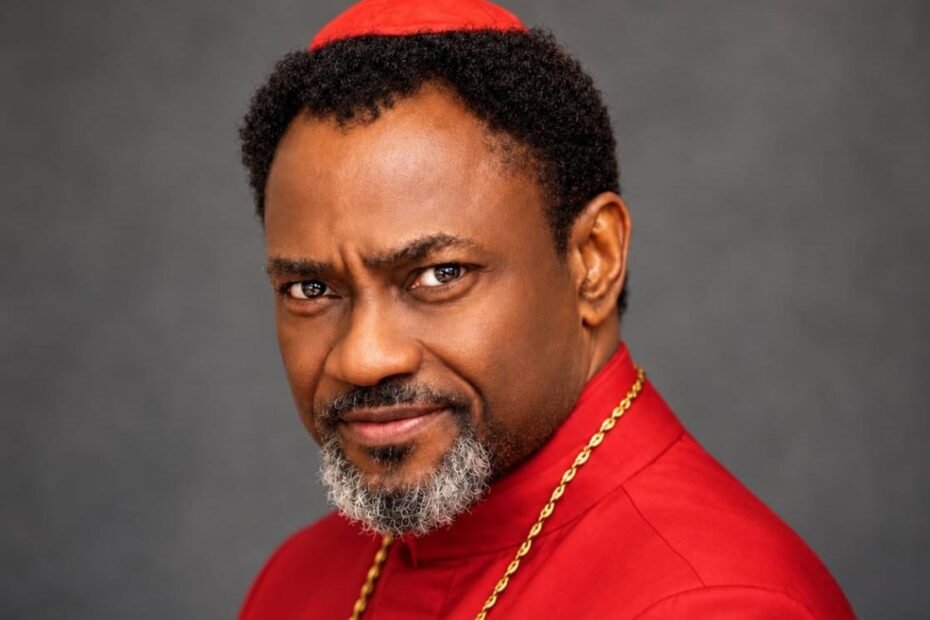
Also spoke about the Nigerian Church, money and ministry, the restoration of wounded believers, Governor Bassey Otu’s record, President Tinubu’s reforms and the years he has left to fulfil his calling.
 By Staff Reporter
·
Published on September 28, 2026
·
13 min read
By Staff Reporter
·
Published on September 28, 2026
·
13 min read
At a media parley in Calabar as part of activities marking his 57th birthday anniversary celebration, Archbishop Josef Bassey warned that Senate President Godswill Akpabio’s description of Cross River State as landlocked could inflame relations with neighbouring Akwa Ibom.
The Territorial Archbishop of Calabar and Presiding Archbishop of God’s Heritage Centre Worldwide also spoke about the Nigerian Church, money and ministry, the restoration of wounded believers, Governor Bassey Otu’s record, President Tinubu’s reforms and the years he has left to fulfil his calling.
Here are the excerpts of the interview with our reporter:
Q: Congratulations, Archbishop. Fifty-seven. How does it feel?
A: Grateful. Very grateful. But birthdays sound different to me now. When you are younger, you count the years you have lived. At this stage, you ask what you have done with them and what remains to be done.
I am not afraid of getting older. I am afraid of arriving at the end with unfinished work. I want to finish well.
Q: You keep saying that. Do you have a premonition about death?
A: (Laughs.) No. I intend to be here for quite a while. But death should not have to announce itself before an intelligent man examines his life.
I have seen applause and rejection. I have seen doors open and close. None of them is the final verdict.
You cannot mark your own script. You may leave the examination hall excited about what you wrote. That is not your result. Somebody still has to mark the paper.
At 57, I am more interested in the verdict than the applause.
Q: What do you know now that you wish you knew at 30?
A: That getting a result does not necessarily mean you were right. That is a frightening truth.
Something can work and still not be God. You can use faith, intelligence, relationships, even spiritual principles, to arrive somewhere God never sent you.
So I ask fewer questions now about whether something worked. I ask: Was it God?
Success can be more dangerous than failure. Failure often drives you to your knees. Success can persuade you that you are on course when you have missed it entirely.
Q: You sound increasingly critical of modern Christianity. Has Josef Bassey changed?
A: Certainly. If I have walked with God all these years and have not changed, I have not learnt much.
My concern is that Christianity has become terribly centred on the Christian. My breakthrough. My prosperity. My dream. My destiny. My comfort.
Then I look at Jesus and see a Man consumed by His Father’s will. That leaves me with an uncomfortable question: Would Jesus practise the Christianity we practise?
I must address that question to myself before I address it to anybody else.
Q: Are you against the prosperity message?
A: I am against any gospel in which man becomes the centre and God becomes the means.
True prosperity, after the order of Christ and the apostles, is biblical. The scandal begins when Christianity becomes a sophisticated way of using God to achieve whatever I want.
Jesus taught us something far more demanding: lose your life and find His.
Q: Should a pastor be extremely wealthy while members of his congregation are poor?
A: A pastor can legitimately be wealthy. He can also be poor. Neither condition proves his standing with God.
Ask three questions: How did he get it? What has it done to him? What is he doing with it?
Money is a servant. It is a terrible certificate of spirituality. Spiritual authority must never become an instrument for extracting money from vulnerable people.
The shepherd exists for the sheep. The sheep do not exist to finance the vanity of the shepherd.
Q: The Church has faced scandals involving money, sexual misconduct and abuse. Has it lost the moral authority to speak to society?
A: No. The Church has not lost its moral authority to correct society, because its authority does not rest on the perfection of every individual within it. Its authority rests on Christ, who is the light and the standard of the Church and the world.
But the Church must never use that authority to avoid correction. It is an institution of light, and light must shine both inwardly and outwardly. The Church must correct society, but it must also allow Christ to correct the Church. It is a perfecting institution: perfecting the saints and shining forth the light of God to the world.
The Church is not perfect because every member is perfect. It is being perfected by Christ. That is why wrongdoing within the Church must be addressed through its systems of correction, discipline and restoration, not turned into a public spectacle. Those entrusted with responsibility must listen carefully, establish the facts, protect those who have been harmed and act in accordance with Scripture and the Church’s procedures.
The Church is bound to protect people, including those who confess their sins, rather than expose them for public consumption. Accountability is necessary, but it must be exercised with truth, wisdom, confidentiality and a genuine concern for restoration. Confidentiality must never become a cover for wrongdoing, just as public disclosure is not, by itself, justice.
Truth does not destroy the Church. Hypocrisy does. Christianity is Christ, not the worst behaviour of the worst preacher you can find. Christ remains the standard, and the Church must continually return to Him.
Q: You speak strongly about the way Christians treat fallen ministers. Does that come, in part, from your own difficult chapter about ten years ago?
A: Of course it does. It is history now, but it is part of what formed the message I carry.
For many years I had very little patience for a believer’s failure. I knew how to uphold God’s standard. I was still learning how to help a wounded man stand again without lowering that standard. Then life brought me to a place where I needed the mercy I preached.
I was wrong in that season. I went to God, submitted myself to the spiritual authority over my life and received correction. I also discovered what happens when a man is in trouble. Some will pray for him. Some will walk away. Others will make his wound their opportunity. I have lived long enough to know the difference.
That is why I cannot join a Christianity that becomes excited when another servant of God falls. We speak of restoring the fallen, yet too often we abandon them to die. We call it a defence of holiness while we afflict people who are already embattled. Scripture says that those who are spiritual should restore one overtaken in a fault in a spirit of meekness. That instruction has never authorised us to call wrong right. Neither has it authorised us to destroy the person who did wrong.
Jesus told Peter, “When thou art converted, strengthen thy brethren.” I understand that differently now. The Lord did not excuse Peter’s denial. He met Peter beyond it and gave him brethren to strengthen.
Ten years have passed. I have walked with God since childhood; I have laboured, sacrificed, served and kept learning through all the years before and since that chapter. One event belongs in that history. It cannot be allowed to tell the whole story.
I can now sit with a saint who is ashamed to lift his head. I will tell him the truth about what he has done. Then I will stay long enough to help him rise. That is one of the ministries God brought out of that season in my life.
Q: Some people say pastors should stay away from politics. Why have you been so vocal about government?
A: Because the welfare of the people is part of my concern and my calling. I am also a citizen.
The Bible they ask me to preach contains Nathan confronting David, Elijah confronting Ahab and John the Baptist confronting Herod. But there is a danger: the preacher becoming the chaplain of a political party. I reject that absolutely.
A spiritual leader must retain the freedom to say, “Government, you did well here,” and tomorrow say, “Government, this is unacceptable.”
Once access buys your silence, you are no longer a watchman.
You gave Governor Bassey Otu a strong performance assessment. Were you speaking for his government?
I presented evidence. If someone disputes my conclusion, let him dispute the evidence.
I examined what the government inherited and what has happened with debt, revenue, pensions, public assets and infrastructure. I also said publicly that some of the Governor’s appointees are not good enough and should be replaced. That is hardly the language of a government spokesman.
Criticism is not automatically courageous because it is negative. Praise is not automatically sycophancy because it is positive.
My loyalty is to Cross River State under God. Where government does well, I will say so. Where it fails, I will say so.
Q: Senate President Godswill Akpabio has described Cross River as landlocked. What is your response?
A: It is most unfortunate. Cross River State is a littoral state. That is the current reality. For the Senate President to describe her as landlocked is to mislead people who may not know the realities on the ground. His comments are capable of engendering strife between Cross River and Akwa Ibom, two states whose people have lived as neighbours and family for generations.
This is not the first time his remarks about Cross River have caused concern. At his level, he ought to know what his words can do.
The office of Senate President belongs to all Nigerians. It must not be reduced to a platform for parochial quarrels or used to speak of a neighbouring state with such disregard. Cross River’s people deserve respect, especially from someone entrusted with that office.
I spoke earlier this year about our state’s oil wells. My position remains that the evidence must be examined and each state must receive what rightfully belongs to it. Cross River must not take one well belonging to Akwa Ibom. Akwa Ibom must not take one well belonging to Cross River.
The relevant federal agencies are examining the claims. While that work proceeds, no leader should inflame relations between our people. Senator Akpabio should withdraw that description and speak with the restraint his office demands.
Q: Nigeria is hurting economically. How do you assess the country?
A: Nigeria is going through a hard season. There is no virtue in pretending otherwise. You cannot explain macroeconomics to a mother who cannot afford food and expect the explanation to become dinner.
Government may sometimes have to take painful decisions. But reform must eventually arrive at the dining table.
Food. Transport. Energy. Jobs. Small businesses. Purchasing power.
Those are not footnotes to economic reform. That is where ordinary Nigerians experience government.
Q: Are President Tinubu’s reforms working?
A: Some reforms have an economic rationale. That is different from saying every implementation has worked well or that the hardship is acceptable.
I would judge policies by measurable outcomes rather than political slogans. Are prices stabilising? Is production rising? Are jobs being created? Is purchasing power recovering? Are vulnerable Nigerians being protected?
Governance is stewardship. Show us the fruit.
And insecurity?
Unacceptable.
We cannot become a country where people are murdered and, two days later, everybody moves on because another tragedy has occurred. Every Nigerian life must matter.
I honour the men and women in our security services who put themselves in harm’s way. But the Nigerian state must confront insecurity with political will and without sacred cows.
Protecting life is the first duty of government.
Q: What should Nigerians look for as 2027 approaches?
A: Character, competence, capacity, track record, the quality of a candidate’s team and measurable results.
Stop falling in love with slogans. Ask the person who wants power: What have you managed? What did you leave better? Who are the people around you? What can you execute?
If a leader is asking for another term, examine the first term carefully and let the record speak. Nigeria is too consequential to be governed as an experiment.
You are investing heavily in education. What is fundamentally wrong with the way we educate children?
We prepare too many children to pass examinations and too few to master life.
A child can leave school with excellent grades and still be unable to manage money, communicate an idea, lead people, recover from failure or stand alone for what is right.
That is educated incompleteness. Education must develop intellect, character, leadership, creativity, enterprise and responsibility.
I do not merely want children who know answers. I want children who know what to do when nobody has given them the answer.
Q: Is artificial intelligence an opportunity or a threat?
A: Both.
AI can make intelligent, disciplined people extraordinarily productive. It can also allow lazy people to outsource thinking.
I want our children to master it. Use the machine, but do not surrender your mind to it. AI can process information. It cannot take responsibility for your character, become your conscience or answer to God for you.
Q: What do people most misunderstand about Josef Bassey?
A: Probably my certainty. Because I speak strongly, people sometimes assume I do not question myself. I do, sometimes brutally.
I have changed my mind when greater light came. I expect to keep learning. But when I have prayed, searched and become persuaded, I do not need a crowd to stand with me.
I would rather stand alone with what I believe to be true than be comfortable in the wrong company.
You speak about Christianity “after the order of Christ.” Is this another denomination in the making?
God forbid that, after all these years, my great contribution should be another signboard. We have enough denominations.
My burden is recovery. Jesus must become the pattern again.
Grace must produce transformation. Power must serve mission. Prosperity must serve purpose. The Kingdom must take precedence over personal ambition. And obedience must remain obedience when it costs you.
If that becomes a movement, wonderful. But let the movement belong to Christ.
Q: When the cake has been cut, the messages have stopped and everyone has gone home, what do you want from the years ahead?
A: Less noise. More consequence.
I want to know God. I want to become more like Christ. I want to finish my assignment.
I want to raise people who surpass me. I want institutions that do not collapse because Josef Bassey is no longer in the room. And I want to leave truth behind that does not need my photograph attached to it before it can travel.
One day, titles, platforms, photographs and applause will mean absolutely nothing. There is one sentence I want to hear:
“Well done.”
If I hear that, I succeeded.
