
The gains are not limited to the RTX 3090 Ti. An RTX 3080 Ti user reported that, with the graphics card’s power limit set to 315 watts, BF16 throughput increased from 71.59 TFLOPS to 113.98 TFLOPS, while TF32 performance rose from 35.65 TFLOPS to 65.28 TFLOPS.
 By Frank Ulom
·
Published on October 24, 2026
·
5 min read
NVIDIA’s GeForce RTX 30 series graphics cards, based on the Ampere architecture and released several years ago, appear to have significant untapped computing potential. A new open-source project called GPU Unlock, developed by GitHub user Zagitta, can remove certain performance restrictions imposed on Ampere-based graphics cards, nearly doubling Tensor Core computing throughput under specific workloads. It does so without modifying NVIDIA’s drivers or permanently flashing the graphics card’s video BIOS (VBIOS).
Interestingly, GPU Unlock builds on earlier research into unlocking NVIDIA’s CMP cryptocurrency mining graphics cards. It combines firmware-unlocking techniques from the CMP project with an early initialisation method that uses a Linux kernel module to perform operations before the NVIDIA graphics driver loads.
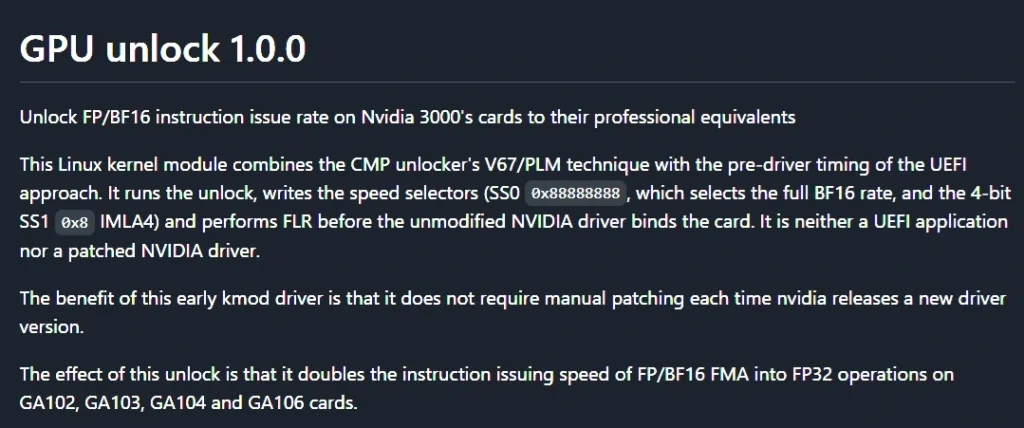
The module modifies the relevant hardware speed-selection registers and performs a function-level reset (FLR). The original NVIDIA driver can then initialise the graphics card normally.
This means users do not need to patch the driver every time they install a new version. The developer currently lists support for the GA102, GA103, GA104 and GA106 GPU models, covering most of the RTX 30 series. However, compatibility is not guaranteed for every graphics card, nor is a performance improvement assured.
Benchmark Results Show Significant Performance Gains
The performance improvements can be substantial. According to benchmark data published in the project’s GitHub repository, an RTX 3090 Ti with its power limit set to 450 watts recorded the following results in a dense matrix multiplication (GEMM) test using FP32 accumulation.
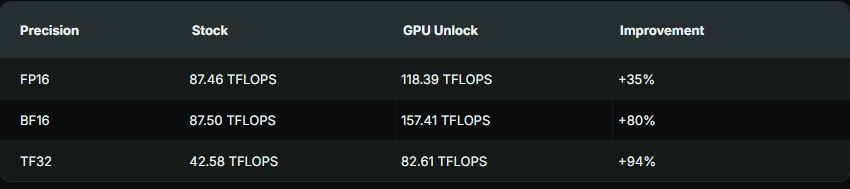
The gains are not limited to the RTX 3090 Ti. An RTX 3080 Ti user reported that, with the graphics card’s power limit set to 315 watts, BF16 throughput increased from 71.59 TFLOPS to 113.98 TFLOPS, while TF32 performance rose from 35.65 TFLOPS to 65.28 TFLOPS.
Another compatibility report for the RTX 3080 10GB showed that FP16/BF16 performance increased from approximately 65 TFLOPS to between 110 and 113 TFLOPS under the card’s original 320-watt power limit.
These results have also attracted considerable discussion on X.
Real-World AI Tests Report Gains of More Than 50%
How does GPU Unlock perform in practical applications? Community members have begun testing the feature under real AI workloads, with early results appearing promising.
An RTX 3090 Ti user on Reddit conducted benchmark tests using ComfyUI and reported the following improvements:
- MOSS-Image SFT BF16: 58.6 per cent increase in throughput.
- Qwen-Image 2.1 Turbo BF16: 57.2 per cent increase.
- Z-Image Turbo BF16: 56.1 per cent increase.
- MOSS-Image SFT INT8: Only a 0.3 per cent increase.
The tester also reported that the decoded images produced before and after unlocking were identical, suggesting that the performance gains did not affect the final image output in these tests.
Large Language Model Performance Depends on the Workload
Large language model (LLM) inference is another potential beneficiary, although the extent of the improvement depends heavily on the type of workload.
A compatibility report involving an RTX 3090 showed that prompt processing and inference throughput in vLLM increased by 33 per cent, while token generation speed remained largely unchanged.
This is understandable because the decoding stage of large language model inference is often constrained by memory bandwidth rather than the raw computing throughput of Tensor Cores.
As a result, increasing Tensor Core performance does not necessarily translate into faster token generation.
Experimental Windows Version Records an 82.5% Gain
Another development worth noting is an experimental Windows implementation that replaces the original Linux kernel module approach with a UEFI-based method.
The developer has documented a successful test on an RTX 3090, reporting an approximately 82.5 per cent increase in BF16 computing throughput.
However, this implementation remains experimental, supports only specific hardware configurations and is not yet a generally available Windows solution.
GPU Unlock Has Limitations
Despite the reported improvements, GPU Unlock has several important limitations.
The project does not increase memory bandwidth, unlock additional CUDA cores or automatically accelerate every workload. At least one report involving an RTX 3080 Ti 20GB showed that the unlocking process completed successfully but did not deliver the expected BF16 performance improvement.
This demonstrates that the results are not universal and may vary depending on the specific graphics card and workload.
Gaming performance is another area where expectations should remain realistic. NVIDIA’s Deep Learning Super Sampling (DLSS) technology also uses Tensor Cores, but there is currently no reliable evidence that GPU Unlock improves gaming frame rates or reduces DLSS processing times.
Performance gains are possible only when a workload uses the affected instructions and accumulation modes. Consequently, the impressive computing benchmarks should not be interpreted as evidence that gaming frame rates will increase by a similar margin.
A Promising Development for Local AI Users
Despite these limitations, GPU Unlock offers an interesting opportunity for owners of NVIDIA RTX 30 series graphics cards, particularly those using their hardware for local AI inference, image generation and other computationally intensive tasks.
The project remains experimental, and compatibility and performance improvements are not guaranteed. Nevertheless, its ability to extract substantial additional computing performance from existing graphics cards without permanently modifying their hardware makes it a potentially valuable development for the local AI community.
