
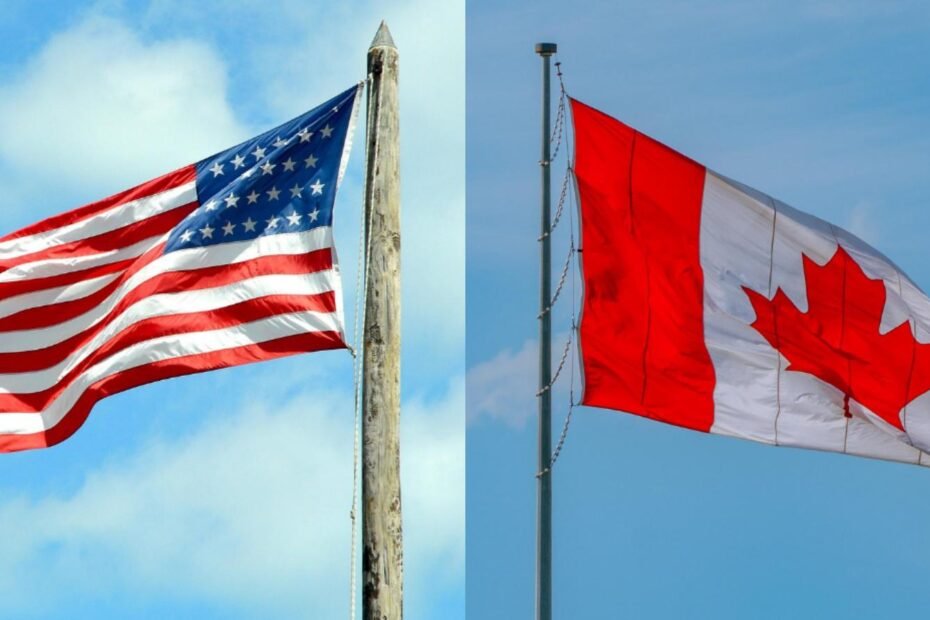
Trade negotiations broke down and tariff disputes escalated, pushing relations between the two major North American countries to a historic low.
 By Sam Ovie
·
Published on September 9, 2026
·
5 min read
By Sam Ovie
·
Published on September 9, 2026
·
5 min read
On September 8, Eastern Time, US President Trump signed a proclamation announcing adjustments to the scope of the additional 50% ad valorem tariffs imposed on certain Canadian products. The adjustments will officially take effect at 00:01 on September 15.
A notice released on the White House website that day indicated that the Trump administration would also ban the import of certain Canadian alcoholic beverages, motor vehicles, and dairy products starting September 29.
The U.S. government previously determined that Canada’s measures in the motor vehicle sector discriminated against and burdened U.S. businesses. To offset these effects, the U.S. previously decided to impose an additional 50% ad valorem tariff on certain Canadian products. The specific products involved are listed in the attached announcement.
Trump also posted on social media that day that he had instructed the General Services Administration to work with the Office of the United States Trade Representative to take all necessary measures to exclude Canadian products from U.S. government procurement programs until Canada restores “fair reciprocity” to U.S. farmers and businesses.
Trump claimed that Canada has been taking advantage of the United States for years, with the Canadian federal and provincial governments prohibiting American small businesses and companies from entering their government procurement markets, while Canada has extensive access to the vast U.S. government procurement market.
However, as of now, the White House, the General Services Administration, and the Office of the U.S. Trade Representative have not officially released any information on this matter.
Starting August 22, the Trump administration imposed a 50% tariff on hundreds of specific goods imported from Canada, including wine and cement. The Canadian government subsequently announced retaliatory measures, imposing tariffs on over 700 U.S. goods worth approximately $20 billion, effective September 8, covering sectors such as steel, aluminum, dairy products, home appliances, and agricultural equipment.
Canadian Prime Minister Mark Carney stated on September 8 that Canada has begun retaliatory measures against U.S. tariffs. Carney said he did not want to escalate the trade conflict, but that retaliatory tariffs against the U.S. were necessary to protect Canadian workers, businesses, and communities. He pointed out that U.S. goods should not be allowed duty-free access to the Canadian market given the U.S. tariffs on Canadian exports.
Carney also stated that Canada has the economic strength to “transform and prosper,” but acknowledged that such a transformation would come at a cost—though “far less than the cost of stagnation.”
Despite the strained relationship, the total value of bilateral trade in goods and services between the United States and Canada is expected to reach nearly $900 billion by 2025, making it one of the largest bilateral trade relationships in the world.
This summer, the United States-Mexico-Canada Agreement (USMCA) reached its statutory review date of six years after its entry into force. However, the United States formally refused to automatically renew the agreement. On July 20, Trump signed several proclamations imposing a 50% tariff on hundreds of specific goods imported from Canada, including wine, hockey sticks, and cement, based on Section 338 of the Smoot-Hawley Tariff Act.
The new measures were originally scheduled to take effect on August 19, but Trump abruptly announced a three-day postponement on August 18. Following the breakdown of negotiations, the United States announced a 50% tariff on approximately $20 billion worth of Canadian goods.
Julián Castro-Rea, a professor of political science at the University of Alberta in Canada, told Jiemian News that scholars who have studied Trump for a long time are familiar with his tactics: first set high standards and obtain the most favorable negotiating space in order to coerce trade partners into reaching a more acceptable solution.
Carney revealed that the U.S. proposed new terms at the last minute that were uneconomical, unfair, and extremely detrimental to Canadian interests, attempting to limit Canada’s ability to reach new trade agreements with other countries and to protect its language, culture, and sovereignty. He added that the proposed terms for the automotive industry were particularly unfair.
At midnight on August 21, Carney decisively announced the suspension of trade negotiations with the United States and recalled his negotiating team. The following day, in a national televised address, he announced that Canada’s retaliatory tariffs would officially take effect on September 8.
During his year-plus tenure as prime minister, Carney completed a systematic deployment across multiple dimensions, including public opinion mobilization, implementation of countermeasures, and bottom-line planning.
He plans to double exports to non-US markets within the next decade, making it an important partner in building an energy powerhouse and achieving economic and trade diversification. He also decided to increase investment in major domestic projects and adjust the focus of immigration policy to match immigration levels with the country’s actual needs and capacity to accept immigrants.
In his speech in Davos this January, Carney criticized U.S. policies for undermining world order, using tariffs as leverage, and employing financial infrastructure as a tool of coercion. Canadians have realized that the complacent notion that geography and alliances automatically bring prosperity and security is no longer valid.
Even U.S. Vice President Vance did not expect that this close northern neighbor would become so assertive.
Meanwhile, Statistics Canada released its “National Tourism and Visitor Survey Report for the First Quarter of 2026,” showing that 5.5 million trips were made to the United States, a sharp drop of 10.6% year-on-year, with 37.5% being day trips. Total spending on trips to the US reached C$5 billion, a decrease of 13.6% year-on-year. Canadian residents made 4.6 million trips to foreign countries (excluding the US), an increase of 6.2% year-on-year; spending reached C$10.1 billion, a significant increase of 16.7%.
