
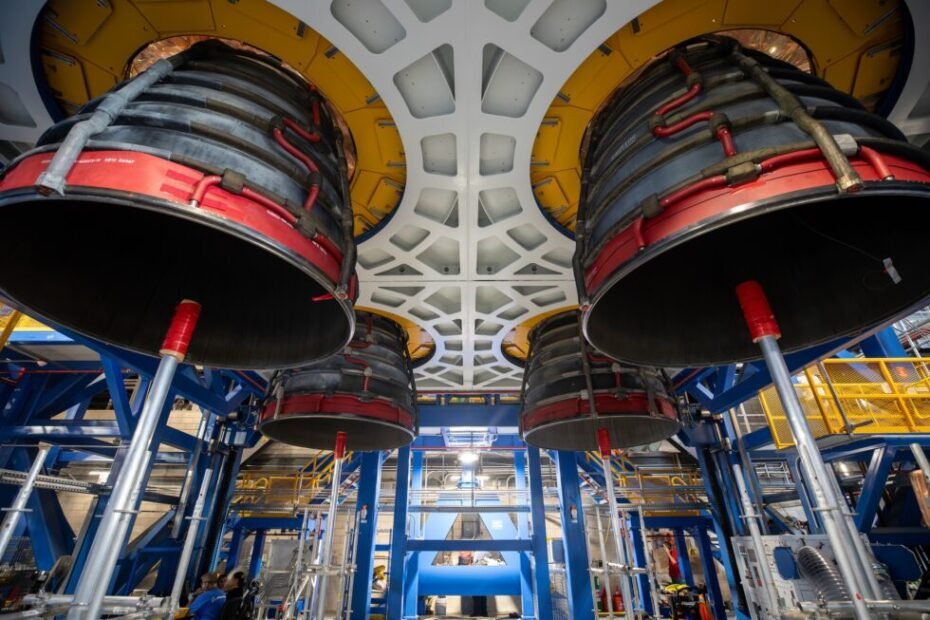
The latest developments include renewed launch attempts by Germany’s Isar Aerospace, fresh funding for European rocket startups, a new NASA approach to purchasing launch services, the debut of China’s Pallas-1 rocket and continued preparations for SpaceX’s next Starship flight.
 By Frank Ulom
·
Published on September 4, 2026
·
9 min read
By Frank Ulom
·
Published on September 4, 2026
·
9 min read
The global space industry is entering another busy phase, with commercial launch companies in Europe, the United States and China advancing new rockets while established space agencies continue deploying increasingly sophisticated spacecraft.
The latest developments include renewed launch attempts by Germany’s Isar Aerospace, fresh funding for European rocket startups, a new NASA approach to purchasing launch services, the debut of China’s Pallas-1 rocket and continued preparations for SpaceX’s next Starship flight.
Blue Origin pushes ahead despite New Glenn setback
Blue Origin has broken ground on a new Payload Processing Facility in Florida as the company continues rebuilding infrastructure around its New Glenn launch system.
The development comes roughly a month after the company last provided significant public information about its heavy-lift New Glenn rocket, which remains grounded following an on-pad explosion at Cape Canaveral Space Force Station in May.
Blue Origin maintains that it is targeting a return to flight before the end of the year, although the timeline remains uncertain.
The new facility is being built under a $78 million contract awarded to Blue Origin by Space Systems Command last year. Scheduled for completion by 2028, the 120,000-square-foot facility will process spacecraft and payloads for national security, civil and commercial missions.
The facility will not be restricted to Blue Origin missions. It is intended to support launch providers carrying national security payloads.
Blue Origin chief executive Dave Limp said the facility will include four payload processing bays, two encapsulation bays and a multi-manifest area.
It will also be large enough to accommodate the planned 25.5-foot (8.7-metre) payload fairing for an upgraded version of New Glenn.
The company is simultaneously rebuilding its damaged Launch Complex 36 and constructing a second launch pad at Cape Canaveral.
Isar Aerospace prepares another Spectrum attempt
German launch startup Isar Aerospace is preparing for another attempt to place its Spectrum rocket into orbit from Andøya Spaceport in Norway.
A week-long launch window is scheduled to open on September 4, with the company aiming to deploy several small CubeSats using the two-stage rocket.
The mission follows the failure of Spectrum’s first test flight shortly after liftoff last year.
Since January, Isar has made several attempts to launch its second Spectrum vehicle, but technical problems and periods when the northern Norwegian launch range was unavailable have prevented liftoff.
The latest launch opportunity comes as Norway observes a period of national mourning following the death of King Harald V.
Isar founder Daniel Metzler told Norwegian Broadcasting Corporation that he hoped to launch before the King’s funeral on September 9. The Norwegian government has indicated that the mission can proceed during the mourning period.
Isar also recently secured a €200 million ($230 million) European Space Agency contract to support development of future launch vehicles.
European rocket startups secure fresh funding
European launch startups are attracting significant new investment as the continent seeks to build greater independent access to space.
Spanish launch services company PLD Space has raised an additional €108 million ($126 million) as it prepares for the first orbital launch of its Miura 5 rocket.
The latest funding round was led by Japan’s Mitsubishi Electric Corporation.
The fundraising came less than a week after PLD Space secured a €159 million ($185 million) contract under the European Space Agency’s European Launcher Challenge programme.
German launch company HyImpulse has also expanded its Series A funding round by more than €50 million ($58 million), taking its total funding to €125 million ($145 million).
HyImpulse is preparing for a second flight of its suborbital SR75 rocket and the first launch attempt of its larger SL1 orbital-class vehicle.
NASA considers bulk rocket purchases
NASA is consolidating several launch programmes under a new Commercial Access to Space office that could introduce bulk purchases of rocket launches.
The office, established within NASA’s Human Spaceflight Mission Directorate, will oversee NASA launch activities outside human spaceflight.
Pete Wilczynski, a NASA official responsible for science missions within the office, said consolidating launch requirements could allow the agency to combine demand and purchase launches in larger quantities.
The strategy is similar to the US Space Force’s approach to launch procurement.
The Space Force guarantees major launch providers such as SpaceX and United Launch Alliance a certain number of contracts over several years, potentially reducing government launch costs while providing launch companies with greater business certainty.
Wilczynski said NASA could consider procurements involving five, 10, 15 or even 20 rockets at a time.
China’s Pallas-1 makes debut
Chinese commercial launch company Galactic Energy has announced the successful first launch of its Pallas-1 rocket.
The medium-class vehicle is designed to carry up to about 7,000 kilograms to low-Earth orbit and is the sixth new Chinese rocket to debut this year.
It is also the fifth new Chinese launcher this year designed with a potentially recoverable and reusable first stage.
Galactic Energy previously developed the Ceres-1, an expendable solid-fuel rocket that has completed 23 missions carrying small satellites into low-Earth orbit.
However, independent confirmation of the Pallas-1 mission’s orbital success remained limited.
The US Space Force had not added the rocket’s upper stage or payloads to its space-object catalogue by late Thursday.
Jonathan McDowell, a prominent spaceflight tracker, also noted that Galactic Energy had not publicly disclosed the orbit’s altitude or inclination.
He therefore said the success of the launch could not yet be considered fully confirmed.
Long March 6C upper stage breaks apart
China’s Long March 6C has suffered another orbital debris incident after its upper stage fragmented days after launching a seven-satellite rideshare mission.
The rocket launched on August 24, while commercial space surveillance company LeoLabs detected the upper-stage breakup less than two days later.
LeoLabs estimated that tens to hundreds of fragments were generated.
The incident adds to concerns surrounding China’s Long March 6 rocket family, particularly the Long March 6A.
More than 1,200 pieces of debris have previously been catalogued from two Long March 6A upper-stage breakups in 2022 and 2024.
The relatively low orbit of the latest fragmentation means much of the debris is expected to re-enter Earth’s atmosphere within several years.
Ariane 6 completes first GTO mission
Europe’s Ariane 6 has completed its first mission to geostationary transfer orbit, carrying the MTG-I2 weather satellite for European meteorological organisation Eumetsat.
The two-booster Ariane 62 lifted off from Kourou, French Guiana, on August 27 and released the spacecraft roughly 30 minutes later.
The satellite, which will eventually be renamed Meteosat-14, will use its own propulsion system to reach an operational orbit nearly 36,000 kilometres above the equator.
From there, it will provide continuous weather observations covering Europe, Africa and the Middle East.
The mission also marked Eumetsat’s return to European launch services after its previous weather satellite was launched aboard a SpaceX Falcon 9 in 2025.
Following delays to Ariane 6’s debut and production ramp-up, several European customers turned to overseas launch providers after Ariane 5 was retired in 2023.
Ariane 6 has now completed eight flawless missions in nine launches since its first test flight in 2024.
India launches new Earth-observation satellite
India has successfully launched the EOS-05 Earth-observation satellite aboard a Geosynchronous Satellite Launch Vehicle.
The rocket lifted off from the Satish Dhawan Space Centre at Sriharikota and reached the designated orbit approximately 18 minutes later.
The roughly 2.5-tonne satellite carries an Earth-facing telescope designed to provide near-continuous observations of the same region from geosynchronous orbit.
EOS-05 replaces GISAT-1, which was lost following a GSLV launch failure in 2021.
Although geosynchronous orbit is unusually high for an Earth-observation spacecraft, its position allows a satellite to continuously monitor a fixed geographic region.
The telescope is designed to capture optical imagery at a maximum resolution of about 42 metres.
NASA’s Roman Space Telescope reaches space
NASA’s $4.3 billion Nancy Grace Roman Space Telescope has launched on a Falcon Heavy rocket from Kennedy Space Center in Florida.
The observatory carries a 300-megapixel camera and will investigate some of the biggest mysteries in modern astronomy, including the forces driving the expansion of the Universe.
Roman will complement the work of the Hubble and James Webb space telescopes while providing a field of view roughly 100 times wider than Hubble.
It is only the second NASA-led astrophysics mission to launch this century after Webb’s 2021 deployment.
SpaceX’s Falcon Heavy carried Roman towards its eventual operating location near the L2 Lagrange point, approximately one million miles from Earth.
The mission marked the 13th flight of Falcon Heavy.
The rocket’s two side boosters successfully returned to Cape Canaveral Space Force Station for planned reuse on another Falcon Heavy mission later this year.
Starship prepares for Flight 14
SpaceX has completed a static-fire test of the Super Heavy booster as preparations continue for the next Starship test flight.
The massive first-stage booster fired all 33 engines at Starbase, Texas, on August 28.
The test followed a firing of Starship’s six-engine upper stage earlier in August.
The tests are part of preparations for Flight 14, which is expected later this month.
The mission is significant because it is expected to be the first Starship flight to attempt to reach low-Earth orbit after the programme’s previous 13 test flights targeted suborbital trajectories.
Flight 14 is also expected to carry SpaceX’s next-generation Starlink Version 3 satellites.
The larger V3 satellites are too big for Falcon 9 and are designed to offer substantial performance improvements over the Starlink V2 spacecraft currently operating in the company’s satellite network.
SpaceX has not disclosed how many V3 satellites will fly on the mission.
Next three launches
| Date | Rocket | Mission | Location | Time |
|---|---|---|---|---|
| September 4 | Spectrum | Onward and Upward | Andøya Spaceport, Norway | 20:00 UTC |
| September 6 | Falcon 9 | Starlink 15-24 | Vandenberg Space Force Base, California | 10:59 UTC |
| September 9 | Long March 2D | Unknown payload | Jiuquan Satellite Launch Centre, China | 09:00 UTC |
