
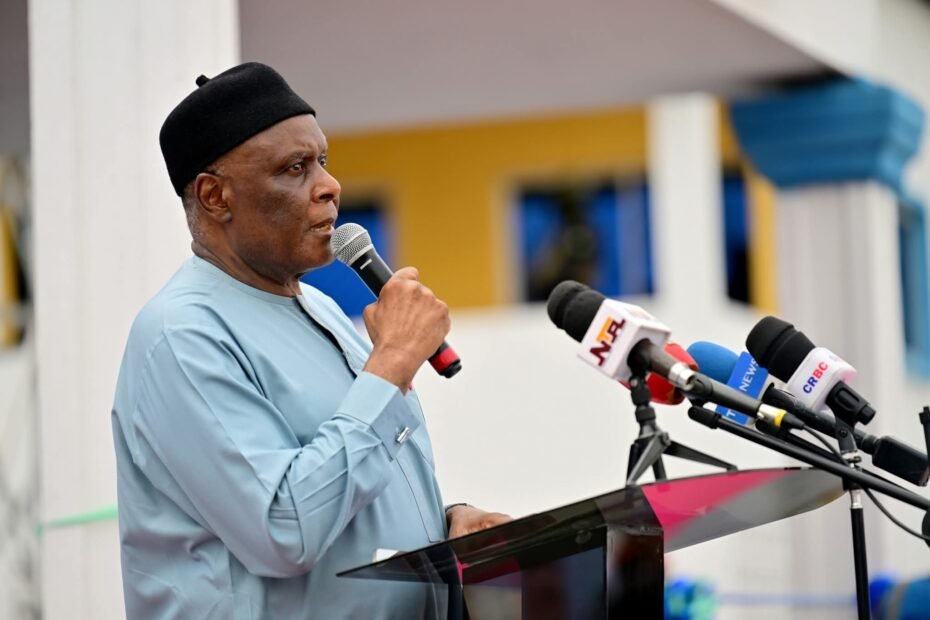
Says his relationship with the Nigerian Chronicle began in August 1978 when he joined the newspaper as an economics editor shortly after completing his National Youth Service.
 By Frank Ulom
·
Published on September 3, 2026
·
6 min read
By Frank Ulom
·
Published on September 3, 2026
·
6 min read
Former Cross River State Governor, Chief Clement Ebri, has urged the state government to reposition the Nigerian Chronicle as a modern media institution capable of competing in Nigeria’s changing digital landscape.
Ebri made the call on Thursday, September 3, 2026, during the official commissioning of the state-of-the-art Government Printing Press and the reactivation of the Cross River State Newspaper Corporation on Barracks Road, Calabar.
The former governor, who described the occasion as deeply personal, said his relationship with the Nigerian Chronicle began in August 1978 when he joined the newspaper as an economics editor shortly after completing his National Youth Service.
He recalled working under Ray Ekpu, who was then editor, with Chief Efiong Essien as General Manager and Mr Nyong Udoeyop as Chairman of the Board.
According to Ebri, he later became Features Editor and subsequently Acting Editor in 1980 after Ekpu left for the Sunday Times.
He said the Chronicle of that era was more than a newspaper, describing it as an institution that provided quality journalism, nurtured professionals and gave Cross River State a voice across Nigeria.
Ebri recalled that the newspaper once recorded daily print runs of about 80,000 copies, rising to approximately 120,000 copies on some occasions.
He said the newspaper had correspondents in major Nigerian cities, including Ibadan, Sokoto, Lagos and Port Harcourt, while producing first and second editions, Sunday editions and occasional special editions.
The former governor also recalled the newspaper’s coverage of the 1979 elections, saying major developments sometimes warranted the production of evening editions.
He said the Chronicle’s strength was not only in its circulation but also in the quality and independence of its journalism.
“Truth and Service,” according to Ebri, was more than the newspaper’s motto, describing it as an editorial responsibility, professional ethic and covenant with the public.
He said the newspaper gave him professional exposure that opened doors to opportunities beyond Cross River State, including a 1979 journalism programme in the United States.
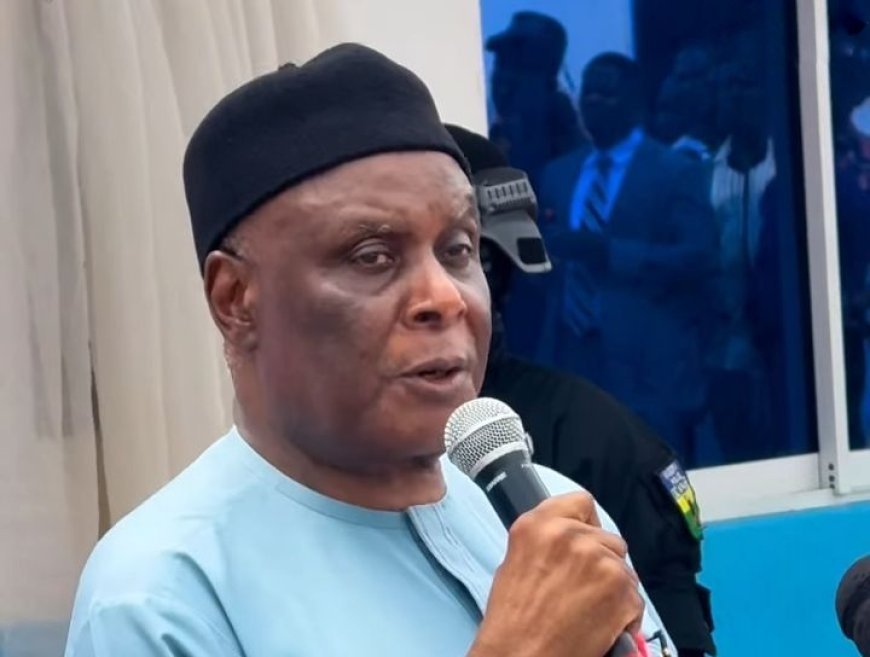
Ebri said he was among 10 Nigerian journalists selected for the programme and spent about a month attached to the Milwaukee Courier, where he gained valuable editorial and professional experience.
He added that his work with the Chronicle also enabled him to cover major events and interview prominent Nigerians, including former Central Bank of Nigeria Governor, Mr Ola Vincent, and renowned businessman Chief Gamaliel Onosode.
According to him, the experience reinforced his belief that newspapers are not merely businesses but institutions for building people, preserving history and giving communities a voice.
‘EndSARS crisis destroyed part of Chronicle’s history’
Ebri, however, lamented the decline in the newspaper’s standards over the years, attributing part of the problem to the departure of experienced journalists without adequate replacement.
He also recalled the damage suffered by the Chronicle’s premises during the 2020 #EndSARS crisis.
He said the incident resulted in the destruction of equipment, books, records and newspaper cuttings, describing the loss as a blow to the institutional memory of both the newspaper and Cross River State.
The former governor therefore called for the restoration of the Chronicle’s library and archives.
“Our archives are not simply old papers. They are the memory of a people,” he said.
Ebri urged Cross Riverians and institutions with old copies of the Chronicle, photographs, newspaper cuttings and other historical materials to donate them towards rebuilding the newspaper’s archives.
He said preserving the materials would help prevent the distortion or loss of the state’s history.
Ebri recalls support for Chronicle as governor
The former governor also recalled his efforts to strengthen the newspaper after assuming office as governor in January 1992.
He said he visited the Chronicle shortly after his inauguration because of his longstanding connection with the institution.
Ebri said his administration subsequently provided equipment, including satellite dishes, Apple computers and cameras, while also supporting the expansion and reorganisation of the organisation.
He said his continued interest in the newspaper was driven by his understanding of its potential to serve as an important institution of public communication.
The former governor commended Governor Bassey Otu for embracing the idea of reviving the Chronicle, saying the governor’s commitment had contributed to the newspaper’s present revitalisation.
He also commended the management and staff of the Cross River State Newspaper Corporation for their role in bringing the institution to the point of reactivation.
‘Revival must be beginning, not conclusion’
Ebri cautioned that the commissioning should not mark the end of the revival process but the beginning of a new chapter for the newspaper.
He said the state should not merely attempt to recreate the Chronicle of the past but should build a newspaper suited to the future.
“The world has changed. The media landscape has changed. The way people receive, consume and share information has changed,” he said.
He argued that technological advancement should not be regarded as a threat to print journalism, insisting that print and digital platforms could complement each other.
According to him, the Chronicle should strengthen its digital presence and distribute its journalism through print, online platforms, social media, video and other emerging communication channels.
He further called for investment in investigative journalism, professional training and the development of a new generation of journalists.
Ebri said the newspaper should also work towards regaining a strong regional presence.
He said the central question should no longer be how to save the Nigerian Chronicle, but how to reposition it so that it matters again.
Ebri seeks collective support
The former governor also called for collective ownership of the newspaper’s revival.
He urged government officials, journalists, academics, business people, professionals and other Cross Riverians to support the Chronicle by reading it, advertising in it, writing for it and holding it to high professional standards.
He said the newspaper should not only report developments in Cross River State but should also contribute to shaping discussions about the state’s future.
Ebri stressed the need for accuracy, credibility and professionalism in an era where information travels rapidly.
“Speed, however, must never replace accuracy. Visibility must never replace credibility. Technology must never replace responsibility,” he said.
He urged the Chronicle to reclaim its position as a trusted institution of public communication while preserving the values of truth and service.
Ebri concluded by describing the reactivation as more than the commissioning of a renovated facility, saying it represented the restoration of a legacy that had survived difficult periods.
He expressed hope that the newspaper would once again become a training ground for journalists, a platform for public scrutiny and a credible voice for Cross River State.
He said the Chronicle should tell the story of Cross River not only to residents of the state but to Nigeria, Africa and the wider world.
“May the presses roll again. May the pages speak again. May the voices of our journalists be heard again. May the archives be restored,” Ebri said.
He added that the renewed Chronicle should tell a story of truth, service and resilience while ensuring that the history of Cross River State was preserved for future generations.
