
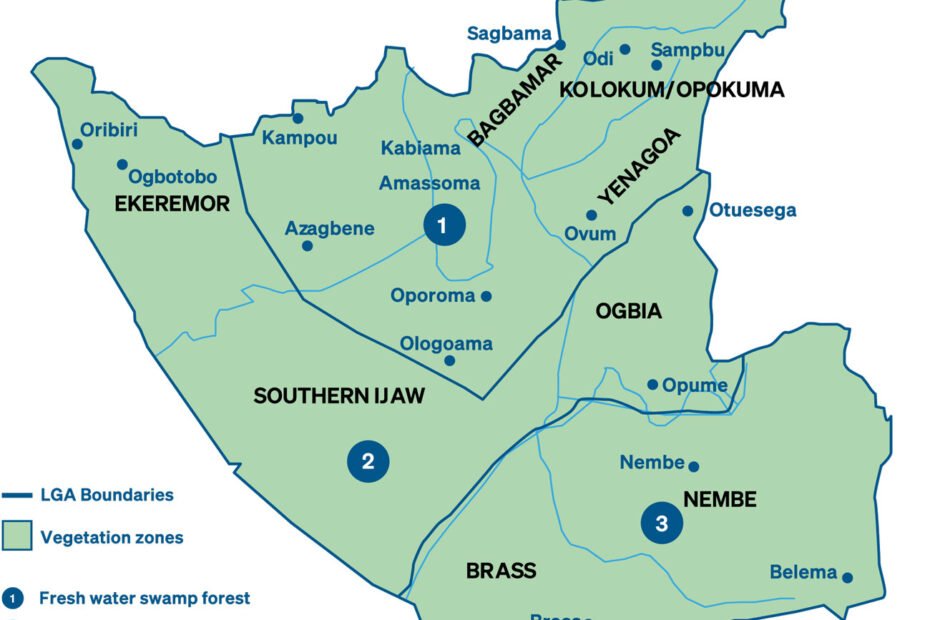
From Diepreye Alamieyeseigha to Goodluck Jonathan and Henry Seriake Dickson, the state remained one of the Peoples Democratic Party’s most reliable fortresses in the Niger Delta.
 By Okoi Obono-Obla
·
Published on October 14, 2026
·
5 min read
Bayelsa State has been a PDP-controlled state since the inception of democratic rule in 1999. From Diepreye Alamieyeseigha to Goodluck Jonathan and Henry Seriake Dickson, the state remained one of the Peoples Democratic Party’s most reliable fortresses in the Niger Delta. This dominance was reaffirmed in the 2023 presidential election when the PDP candidate, Atiku Abubakar, won Bayelsa with 68,818 votes, ahead of Peter Obi of Labour Party with 49,975 votes and Bola Tinubu of the APC with 42,572 votes.
That order was broken in 2025 when a seismic political shift occurred. Governor Douye Diri, who had won re-election on the PDP platform in the November 11, 2023 off-cycle governorship election and was sworn in for a second term on 14 February 2024, resigned from the PDP on 15 October 2025 and was formally received into the All Progressives Congress (APC) on 3 November 2025 in Yenagoa by Vice President Kashim Shettima and the APC National Working Committee. He defected with his Executive Council, federal and state lawmakers, and the party structure across the state.
It is now almost four years since the 2023 election, and a lot of political water has passed under the bridge. The dynamism that shaped 2023 will be different from what will shape 2027.
The first dynamic is incumbency. The APC will go into the 2027 general elections with an incumbent Governor Douye Diri in its kitty. In Nigerian political calculus, governors are formidable centres of political control and mobilization who cannot be dismissed with a wave of the hand. Although Diri is in his second and final term which runs until February 2028 and therefore will not be on the ballot as Bayelsa will have no governorship election in 2027 — it being one of eight off-cycle states — he will remain the key mobilizer for the presidential, National Assembly and State Assembly elections.
According to INEC, the 2027 elections in Bayelsa will be for President, three senatorial seats, five House of Representatives seats and 24 State House of Assembly seats. The Commission has listed 45 senatorial candidates for Bayelsa — 17 in Bayelsa West, 15 in Bayelsa Central — and 250 candidates for the State Assembly.
The second dynamic is the allure of the centre. There is a long-held belief in Bayelsa as a minority state that it should remain at the fulcrum of national mainstream politics to benefit from federal patronage and attract development. That belief is reinforced by recent federal reforms in the oil and gas sector. The Federal Government has pointed to the $800 million Final Investment Decision (FID) on the Ima Gas Field by AMNI International and TotalEnergies — a field discovered in 1973 but undeveloped for over five decades — as proof that investor confidence is returning. Along with three other gas projects valued at $3.5 billion combined, this investment drive resonates in a core oil state like Bayelsa and is one of the factors that could sway the electorate toward President Bola Ahmed Tinubu, benefiting from both federal and state incumbency.
The third dynamic is the emergence of a new party with home roots. Senator Henry Seriake Dickson, Governor of Bayelsa from 2012 to 2020 and currently Senator representing Bayelsa West, dumped the PDP to become the founder and National Leader of the Nigeria Democratic Congress (NDC), a party registered by INEC in February 2026. Dickson, who held his party’s maiden national convention in Abuja, says the NDC is built as a durable, ideology-based alternative for stranded politicians.
How his people will accept a party founded by him is the critical question.
Projected Party Standings:
- APC – The Party to Beat: The APC enters 2027 with a double advantage — federal incumbency and state incumbency. With Diri controlling the state machinery, the party is projected to significantly improve on the 42,572 presidential votes it scored in 2023 and be highly competitive in all three senatorial districts and the State Assembly.
- PDP – A Fortress Lost: For the first time since 1999, the PDP goes into a general election in Bayelsa without control of the Government House. Having lost its governor and structure to the APC in 2025, it must rely on residual loyalty and nostalgia. It is now the opposition.
- NDC – The Wild Card: The NDC’s strength will be tested in Dickson’s backyard. Bayelsa West — Sagbama and Ekeremor — remains his stronghold. If he retains his senatorial seat on the NDC platform, it will legitimize the party and give it a foothold in Bayelsa Central and parts of the state legislature. It is unlikely to displace the APC state-wide in 2027, but it could split the traditional PDP vote and become the second force in Bayelsa West.
In sum, Bayelsa in 2027 is no longer a PDP fortress. It is a three-way contest: an APC buoyed by an incumbent governor and presidential power, a PDP fighting to preserve its identity, and an NDC leveraging Seriake Dickson’s personal legacy to carve out a new political home.
