
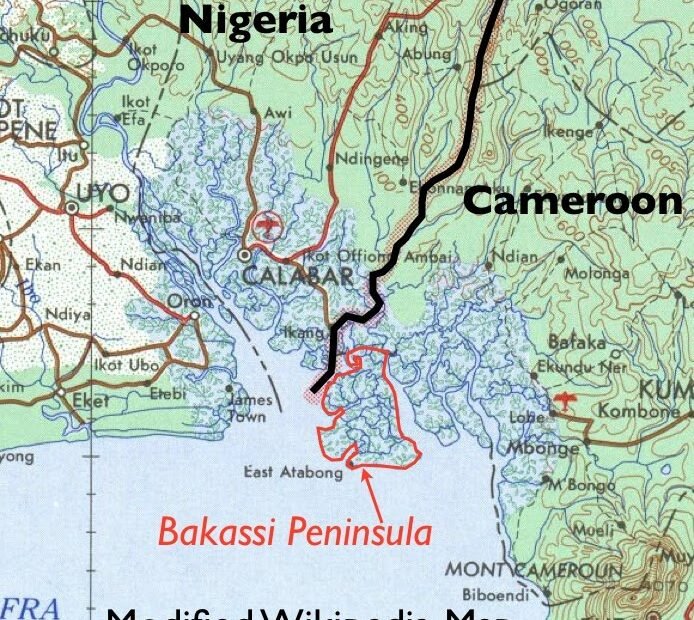
The maritime corridor encompassing Abana Island, Dayspring Island and Kwa Island within the Bakassi Deep-Sea environment possesses unique geological, hydrographic and strategic advantages
 By John Lebo
·
Published on June 26, 2026
·
6 min read
By John Lebo
·
Published on June 26, 2026
·
6 min read
Across the world, the oil and gas industry is undergoing a major transformation. The era of easily accessible onshore and shallow-water petroleum resources is gradually giving way to deepwater and ultra-deepwater exploration and production.
From Brazil to Guyana, Angola to Norway, and increasingly across the Gulf of Guinea, the future of hydrocarbon development lies offshore. Nigeria is not exempt from this transition.
Most of Nigeria’s future reserve growth and production expansion will come from deep offshore fields, subsea developments, floating production systems, offshore gas projects and emerging blue economy investments.
This shift presents both a challenge and an opportunity.
The challenge is that Nigeria currently relies heavily on foreign shipyards and offshore engineering facilities for the construction, integration, refurbishment and maintenance of Floating Production Storage and Offloading Facilities (FPSOs), LNG carriers, offshore support vessels and other critical energy infrastructure.
The opportunity is that Nigeria can develop its own world-class offshore industrial ecosystem to support this emerging energy future.
This is where Cross River State enters the conversation.
The maritime corridor encompassing Abana Island, Dayspring Island and Kwa Island within the Bakassi Deep-Sea environment possesses unique geological, hydrographic and strategic advantages that position it as one of the most suitable locations in Nigeria for the establishment of a major FPSO Integration and Maintenance Hub, LNG logistics facilities, offshore fabrication yards and a deepwater shipbuilding and repair complex.
The proposed development is not simply about building a shipyard. It is about creating a new maritime-industrial economy that can serve Nigeria, the Gulf of Guinea and the wider African offshore energy market.
The case for Cross River State begins with geography and geology.
The state occupies a strategic position along the eastern maritime corridor of Nigeria and sits within the Calabar Flank and Cross River Basin geological province. This offshore environment is connected to significant hydrocarbon systems extending into the Gulf of Guinea and is already home to important offshore production assets, including OML 114 (Abana Field), OML 123 (Antan Field) and OML 115 (Ekanga and Zafiro Fields). These fields form part of a broader offshore petroleum ecosystem that will continue to attract investment for decades.
Equally important is the elongated continental shelf configuration associated with the Cross River’s offshore environment.
This geological framework provides a natural linkage between offshore production zones and future industrial support facilities. Rather than being located far away from offshore activities, the proposed Bakassi Energy Corridor would be positioned close to existing and future petroleum operations.From a maritime perspective, the advantages are even more compelling.
The Calabar International Navigational Channel, combined with the deepwater environment surrounding the western Bakassi islands of Abana, Dayspring and Kwa Island, provides direct access to the Atlantic Ocean and the Gulf of Guinea.
Unlike many coastal environments that face severe siltation and navigational constraints, the Bakassi Deep-Sea corridor offers the possibility of developing large-scale maritime infrastructure capable of supporting FPSOs, LNG carriers, Very Large Crude Carriers (VLCCs), offshore support vessels and heavy engineering operations.
This is precisely why the proposed Bakassi Deep-Sea Port should not be viewed merely as a conventional port project. It should be conceived as the anchor infrastructure for a broader offshore energy and maritime industrial cluster.
Globally, the demand for FPSOs continues to grow as offshore oil production expands. Industry forecasts suggest that between now and 2050, hundreds of FPSOs will be deployed, upgraded or replaced worldwide. The Gulf of Guinea alone is expected to remain one of the world’s most active offshore hydrocarbon provinces.
Countries such as Nigeria, Equatorial Guinea, Cameroon, Gabon, Angola, Congo and São Tomé and Príncipe will require substantial offshore support services.
Yet there remains a significant shortage of regional facilities capable of handling FPSO integration, maintenance and refurbishment at scale.
This gap represents a multi-billion-dollar opportunity.
A Bakassi FPSO and Offshore Energy Hub could include an FPSO Integration Yard, offshore fabrication facilities, floating dry docks, LNG support infrastructure, marine engineering workshops, subsea technology centres, and maritime research institutions.
Such a development would significantly reduce capital flight while strengthening Nigeria’s local content aspirations.
The economic implications are enormous. Beyond supporting offshore petroleum activities, the project would stimulate industrialisation, technology transfer, employment creation and foreign direct investment.
Thousands of direct jobs and tens of thousands of indirect jobs could emerge from shipbuilding, fabrication, logistics, engineering, maritime services and related industries.
The project also aligns perfectly with Nigeria’s Blue Economy agenda.
In addition to oil and gas, the Bakassi corridor possesses long-term potential for LNG development, offshore renewable energy and emerging green technologies.
As global energy systems evolve, facilities established today for offshore petroleum operations can eventually support floating LNG systems, offshore wind energy projects, hydrogen infrastructure and carbon management technologies.
This long-term flexibility is what distinguishes strategic infrastructure from ordinary infrastructure.
The vision, therefore, extends beyond today’s energy economy.
It is about positioning Cross River State as a future maritime innovation and industrial centre capable of adapting to changing global energy realities.
For decades, discussions about Cross River’s maritime potential have largely focused on ports, shipping and commerce. While these remain important, the next phase of economic thinking must be broader and more ambitious.
The state’s unique combination of offshore hydrocarbon assets, deepwater access, geological advantages, navigational infrastructure and strategic location within the Gulf of Guinea provides the foundation for a globally competitive offshore energy ecosystem.
The convergence of the proposed Bakassi Deep-Sea Port, the Calabar International Navigational Channel, the offshore petroleum fields of Abana, Antan, Ekanga and Zafiro, and the broader Gulf of Guinea energy market creates a rare opportunity that few regions in Africa can match.
The question is no longer whether such a vision is possible.
The question is whether Nigeria is prepared to leverage the natural advantages of Cross River State to establish a world-class FPSO, LNG and Offshore Energy Hub that can serve the nation and the continent for generations to come.
The Bakassi Deep-Sea Corridor represents more than a maritime location. It represents a strategic national asset whose time has come.
Rt. Hon. John Gaul Lebo, Solution Architect, Former Speaker, Cross River State House of Assembly
