
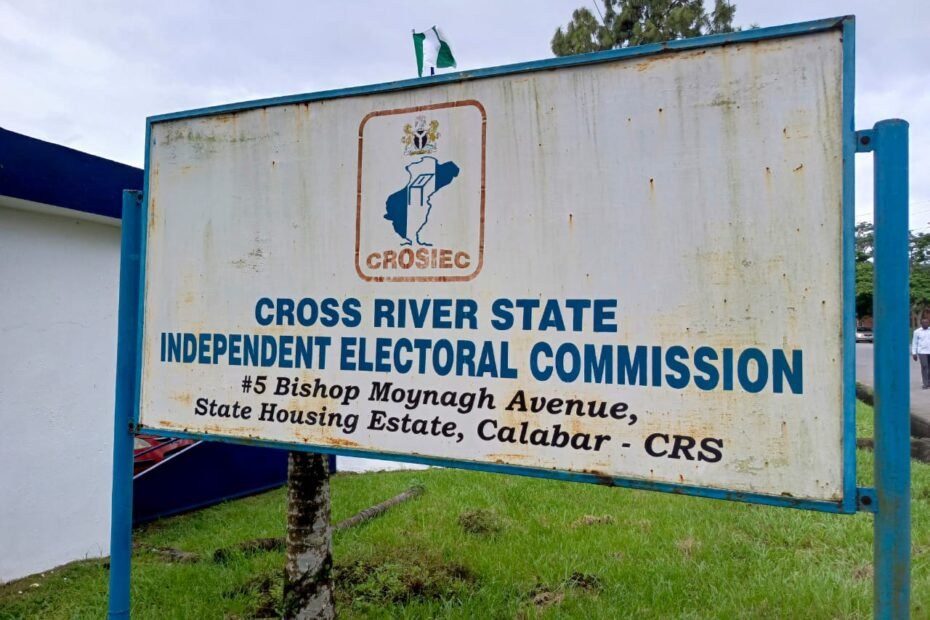
The Bill seeks to repeal the Cross River State Independent Electoral Commission Law No. 18 of 2002 and provide for the establishment of the State Independent Electoral Commission and matters connected therewith.
 By Itam Offor
·
Published on November 19, 2026
·
4 min read
The Cross River State House of Assembly has passed into law a Bill seeking to repeal the Cross River State Independent Electoral Commission Law No. 18, 2002, and provide a new legal framework for the establishment, administration and operations of the Cross River State Independent Electoral Commission (CROSIEC).
The Bill, sponsored by the Deputy Leader of the House and Member representing Abi State Constituency, Rt. Hon. Davies Etta, passed first and second readings on November 4, 2026, following which it was referred to the House Committee on Judiciary, Public Service Matters, Public Petitions and Conflict Resolution for detailed consideration.
Presenting the Committee’s report during plenary, the Chairman, Rt. Hon. Davies Etta, outlined the Committee’s findings and recommendations following its consideration of the Bill and consultations with relevant stakeholders.
Etta disclosed that the Committee conducted a public hearing on November 11, 2026, at the Mini-Auditorium of the Assembly Complex, with participation from leaders of almost all political parties in the State under the aegis of the Inter-Party Advisory Council (IPAC), civil society organisations, political interest groups and other stakeholders.
He said stakeholders generally supported the Bill, noting that the repeal and re-enactment had become necessary following the passage of the Electoral Act, 2026, which requires State Independent Electoral Commissions (SIECs) to align their respective laws with the national electoral framework.
The Committee observed that the existing CROSIEC Law, enacted in 2002 and amended in 2007 and 2024, had become inadequate in addressing current electoral realities. It noted that the Electoral Act, 2026 provides for uniform procedures in voter registration, political party primaries, campaign guidelines and a three-year tenure for Council Chairmen across the Federation. It also requires the publication of the Notice of Election not later than 300 days before an election and provides for early release of funds to SIECs, as well as the recruitment and discipline of their staff without government interference.
Among the major amendments recommended by the Committee is a provision requiring each Local Government Council to contribute one per cent of its monthly allocation from the Federation Account towards funding the Commission’s electoral activities. The Committee further recommended that funds required for elections must be released to the Commission not later than three months before the election to ensure adequate financial preparation.
To strengthen the Commission’s leadership structure, the Committee recommended a provision limiting an Acting Chairman’s tenure to six months, renewable for not more than two instances. It also proposed a new Section 8 to provide separately for the appointment, qualifications and functions of the Secretary of the Commission.
In a move to strengthen accountability and deter misconduct, the Committee recommended an increase in the fine for breach of official duties under Section 62(1) from N5,000 to N2 million. It also recommended the correction of the marginal note in Section 67 from “Threatening” to “Inducement to Vote” to properly reflect the provision.
The Committee further recommended that the long title and Section 82(1) be recouched to expressly provide for the repeal of the existing 2002 Principal Law and its subsequent amendments of 2007 and 2024, thereby establishing a comprehensive and updated legal framework for the Commission.
The new provisions are expected to strengthen CROSIEC’s financial and administrative independence, improve its operational capacity, guarantee timely preparation for elections and promote greater transparency and accountability in the conduct of local government elections.
Contributing to the debate, Members noted that the proposed measures would provide a stronger legal foundation for the Commission, enhance public confidence in the electoral process and ensure credible, transparent and inclusive local government elections ahead of the 2027 Council polls.
Following consideration and adoption of the Committee’s report, the Bill scaled third reading and was subsequently passed by the House.
The new law, comprising five parts and 84 sections, provides for the establishment and composition of the Commission, its functions, appointment and supervision of officers, procedures at elections, election offences and penalties, and other related matters.
In his remarks, the Speaker of the House, Rt. Hon. Elvert Ayambem, commended Members, the Committee and stakeholders for their contributions to the successful passage of the Bill, describing it as an important step towards establishing a stronger legal framework for the conduct of local government elections in the State.
Ayambem expressed optimism that the new law would guarantee greater independence for CROSIEC, strengthen public confidence, improve electoral administration and enhance democratic governance at the grassroots.
He reaffirmed the commitment of the 10th Assembly to enacting legislation that expands democratic opportunities, strengthens public institutions and promotes sustainable development across Cross River State.
