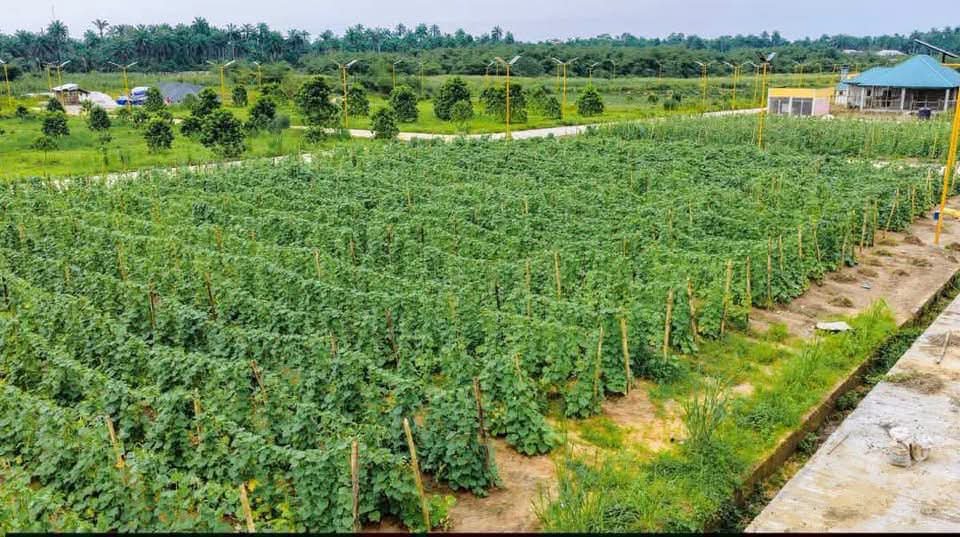

This is the broader ambition behind Ibom Model Farm, an agricultural development project designed to bring different aspects of farming together within one facility.
 By Emmanuel Nzenwa
·
Published on November 10, 2026
·
3 min read
Agricultural development requires more than distributing farm inputs or encouraging people to cultivate land. It also depends on building systems that connect food production with modern farming techniques, practical training, processing and commercial opportunities. This is the broader ambition behind Ibom Model Farm, an agricultural development project designed to bring different aspects of farming together within one facility.
Spanning approximately 50 hectares at Ikot Edibon, in Nsit Ubium Local Government Area of Akwa Ibom State, the project was initiated in 2023 by the Akwa Ibom State Government in partnership with Songhai Farms Initiatives Nigeria. Its approach draws inspiration from the Songhai agricultural model in the Republic of Benin, which promotes integrated farming and the productive use of agricultural resources.
The farm combines different areas of agricultural activity, including crop cultivation and aquaculture, with plans for wider agricultural production, training and value addition. This integrated approach is important because it creates opportunities to connect primary food production with other activities that can increase the economic value of agricultural products.
Images from the facility show cultivated plots, including maize, pineapple and pawpaw, alongside an extensive arrangement of concrete fish-rearing tanks. The farm also has additional buildings and infrastructure under development. These facilities form part of a broader effort to establish an organised agricultural centre rather than a conventional farm focused on only one type of production.
One of the project’s important dimensions is its potential role in agricultural education and skills development. Beyond producing food, a model farm can provide a practical environment where students, young farmers and aspiring agribusiness entrepreneurs learn modern production methods, farm management and the business opportunities available across the agricultural value chain.
In July 2026, the Akwa Ibom State Government transferred the farm’s day-to-day management to Akwa Ibom State University (AKSU), while the Ministry of Agriculture retained supervisory oversight. This arrangement could strengthen the connection between academic knowledge and practical agricultural production, provided the university develops effective training, research and commercial programmes around the facility.
On November 9, 2026, Governor Umo Eno visited the farm in Nsit Ubium as part of an inspection of ongoing projects in the area. The visit included university personnel, following the transfer of management responsibilities to AKSU. The inspection also indicates that development work at the facility is still ongoing, making the completion, effective management and eventual utilisation of its infrastructure important considerations.
If properly completed and sustainably managed, Ibom Model Farm could contribute to food production, employment, agricultural entrepreneurship and the development of agro-processing businesses in Akwa Ibom State. Its long-term value, however, will not be determined by the size of its land or the number of structures on the site alone. It will depend on how productively the facilities operate, the quantity and quality of agricultural output, the opportunities created for farmers and students, and the ability to turn production into viable businesses.
Ultimately, the ambition is to establish a facility where agriculture is not treated simply as subsistence farming, but as a productive sector that can support education, enterprise, employment and economic growth.
See photos below: