
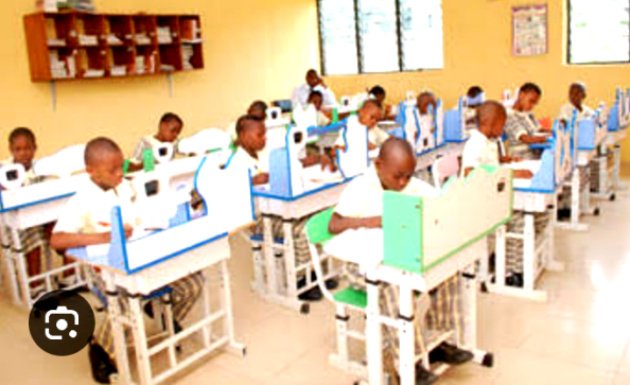
The government achieved this over a three-year period amidst a fresh push to address severe infrastructure deficits in public basic education.
 By Sunday Anthony
·
Published on September 30, 2026
·
3 min read
By Sunday Anthony
·
Published on September 30, 2026
·
3 min read
Akwa Ibom State no Government has completed the rehabilitation of 199 primary and junior secondary schools across the 31local government areas of the state.
The government achieved this over a three-year period amidst a fresh push to address severe infrastructure deficits in public basic education.
The State Universal Basic Education Board (AKSUBEB) also distributed 406,450 teaching and learning items including textbooks, curriculum guides, desks, chairs, and utility equipment to strengthen classroom instruction across the state.
Executive Chairman of AKSUBEB, Anietie Etuk, disclosed this in Uyo during the Ministerial Media Briefing on Education, an event organized to outline sector-by-sector performance under Governor Umo Eno’s ARISE Agenda.
Etuk explained that the intervention projects executed between 2023 and 2026 targeted both physical facilities and learning materials.
Works carried out across schools included the construction and renovation of classroom blocks, administrative offices, perimeter fencing, water schemes, and modern toilet facilities.
Going forward, the board chairman revealed that AKSUBEB is adopting a “whole-school intervention model in line with Governor Umo Eno’s model school policy”.
Under the strategy, selected schools will receive comprehensive upgrades combining perimeter security, clean water supply, modern sanitation, solar lighting, and on-site teachers’ quarters.
“The goal of the whole-school model is to ensure interventions go beyond building classrooms to addressing all environmental factors that hinder effective teaching and learning,” Etuk said.
Unveiling a major recruitment policy shift, the SUBEB chief announced that the state will henceforth recruit teachers locally from their immediate areas of deployment.
The move aims to curb teacher absenteeism and eliminate long daily commutes that affect classroom productivity.
To safeguard the investments, AKSUBEB has launched capacity-building workshops for teachers and School-Based Management Committees (SBMCs) to improve community ownership and administrative efficiency in public schools.
Corroborating the board’s updates, the Commissioner for Education, Prof. Ubong Essien Umoh, stated that state investments including scholarship awards, bursaries, and examination fee subsidies are structured to boost school enrollment and overall academic performance.
Addressing financial figures presented at the briefing, Commissioner for Information Rt. Hon. Aniekan Umanah clarified that funds allocated for capital infrastructure under SUBEB are different from distinct allocations for teacher gratuities, matching grants, or direct student bursaries.
The briefing also featured updates on vocational skills programmes and youth empowerment initiatives driving the administration’s broader human capital agenda.
