
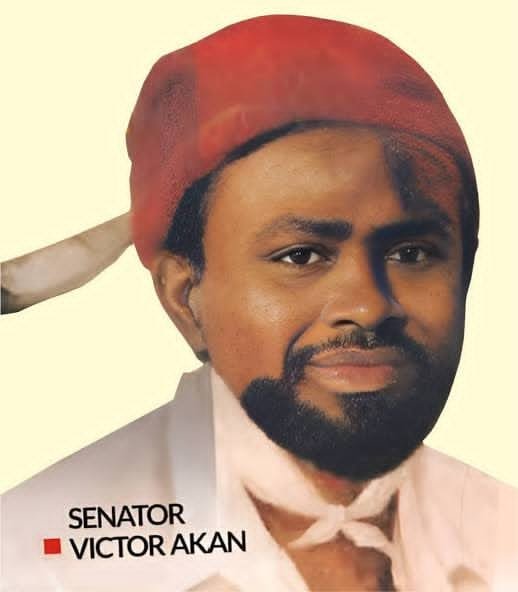
Victor Akan was born on January 21, 1937, in Calabar, to Offong Uwe Otoyo Akan (later Ahta of Oro, Uwe Otoyo Akan 1) and Chief Mrs. Atim Akan. He was the first of their two sons.
 By James Akan
·
Published on September 24, 2026
·
8 min read
By James Akan
·
Published on September 24, 2026
·
8 min read
Long before quantity surveying became firmly established as a distinct profession in Nigeria, and long before political representation, industrial enterprise and public service became the defining measures of his career, Senator Victor Uwe Otoyo Akan had already begun building a life distinguished by professional excellence, enterprise, courage, public service and philanthropy.
Victor Akan was born on January 21, 1937, in Calabar, to Offong Uwe Otoyo Akan (later Ahta of Oro, Uwe Otoyo Akan 1) and Chief Mrs. Atim Akan. He was the first of their two sons.
His early education began at Duke Town School, Calabar, and Government School, Lafiagi, Lagos, between 1945 and 1951. He subsequently attended St. Gregory’s College, Lagos, graduating with the celebrated 1957 set. He belonged to the famous “Log 57” group of Gregorians, sharing the year with such distinguished contemporaries as Chief Debo Akande, Chief Anthony Ani, Engr. Kayode Erogbogbo, Dr. Victor Igbo, Carlos Doregos, Chief Apollonius Nwanze, Patrick Tabiowo and Chief Babs Akerele.
His choice of profession was both pioneering and distinct.Akan studied Quantity Surveying at the College of Estate Management, St Albans, London, United Kingdom, and subsequently continued his professional development at the Australian Institute of Quantity Surveyors in North Sydney, Australia.
Akan attained the highest professional qualifications available to him. He became a Fellow of the Nigerian Institute of Quantity Surveyors and a Fellow of the Australian Institute of Quantity Surveyors.
His professional journey began with a brief period in government service. He later moved into private professional practice in Lagos and Port Harcourt, where he established himself before the outbreak of the Nigerian Civil War.
Akan belonged to a generation of Nigerian professionals who not only practised their professions; but also sought to build the institutions through which those professions could grow.
He was deeply involved in the development and formal recognition of quantity surveying in Nigeria. He played a role in efforts to have the profession properly registered and institutionalised at the federal level.
He also acquired office accommodation on Herbert Macaulay Street, Lagos, and furnished, equipped and staffed the facility for the use of the profession.
That institutional contribution has endured beyond his lifetime. The Nigerian Institute of Quantity Surveyors’ Lagos liaison office is today located at Victor Akan QS House, 17/19 Idowu Taylor Street, Victoria Island, Lagos. His name therefore became permanently associated with the professional body whose growth he had helped advance.
The Nigerian Civil War interrupted the professional and entrepreneurial trajectory he had begun to establish.Akan found himself on the Biafran side. Like countless Nigerians whose lives were overturned by the conflict, he lost much of what he had accumulated before the war.
He nevertheless served during the conflict as a military engineer. He entered the war as a Captain and rose to the substantive rank of Major, serving with the Army Engineers.Colleagues who knew him during the war remembered him as brave, innovative, hardworking and resourceful. His engineering background found practical expression in military service during one of the most difficult periods in Nigeria’s history.
The war also brought an important personal chapter. Akan met Miss Mina Brown in October 1967, and they were married in March 1968. Their marriage was blessed with six children.
When the war ended, Akan returned to civilian life with the determination to rebuild.In 1972, he established his private professional practice, Associated Quantity Surveyors, with its headquarters at 3 Military Street, Onikan, Lagos.
The next sixteen years, from 1972 until his death in 1988, were extraordinarily productive.Associated Quantity Surveyors developed into a major professional practice involved in significant government and private-sector projects across Nigeria. Its operations extended nationwide, including work on the Universal Primary Education programme, for which the firm maintained offices across the states of the Federation.Among the major projects associated with his practice were the Federal Palace Hotel, Lagos; Stock Exchange Building, Port Harcourt; Metropolitan Hotel, Calabar; State Secretariat buildings in Cross River and Akwa Ibom States; Federal Secretariats; the Presidential Lodge; State Library; Cultural Centre; Main Arts Auditorium at the University of Calabar; Naval Hospital; and the institution that later became the Cross River University of Technology, among many other projects.
His professional practice was therefore a successful commercial enterprise and a vehicle through which a young indigenous Nigerian profession participated in the development of modern infrastructure across the country.
Akan’s interests extended well beyond quantity surveying.He developed the Sacramento Estate, Calabar; Toyo Bungalows, Oron; Salutation Hotel, Calabar, now Unical Hotel; and Atlantic House, Calabar.
He was also involved in the establishment of the Nigerian Call and Sunday Call newspapers.
His professional understanding of construction naturally complemented his interest in industrial development.
In 1978, Victor Akan and his brother, Akua, established System Metal Industries Limited in Calabar, producing long-span aluminium roofing sheets.The enterprise was regarded as a pioneering fully Nigerian owned operation in its field.
In 1983, he established another factory in Abuja, at a time when industrial activity in the new Federal Capital was still developing. The factory was reportedly the only roofing factory operating in Abuja at the time.It was against this background that the memorable expression emerged, that “System Metal Industries roofed Abuja.” The company’s work also extended to New Finima, Bonny, Rivers State, where it was involved in the Federal Government resettlement project associated with the Nigerian National Petroleum Corporation.
Akan’s industrial activities were not limited to roofing materials. Together with his friend, Chief Tony Soetan, he established Excel Plastics Industries Limited, manufacturing high-pressure plastic pipes, household plastic utensils and plastic footwear. Some of the footwear became popularly known by the name “Okpo Victor Akan.”
One of the stories that illustrates Akan’s character as both an industrialist and a man with an appreciation for history concerns the renovation of Wesley Cathedral, Calabar.At a critical stage in the renovation, his friend, Engineer B. E. Bassey, who was supervising the project, reportedly contacted him with an urgent message:
“Victor: Be quick! Rain is falling into the Cathedral!” As Chief Executive of System Metal Industries, Akan responded quickly and provided the roofing required.But he did more than provide materials. He took a personal interest in the restoration and insisted that the interior character of the historic cathedral should not be unnecessarily altered. Instead, the décor was to retain the style and character of the period in which the building had been constructed.
In 1979, Victor Akan entered national politics and was elected to the Nigerian Senate, representing Eket Senatorial District, which then comprised the Eket, Oron and Ikot Abasi areas of the old Cross River State.He retained his seat in the October 1983 elections, making him one of the returning senators of the Second Republic.
Akan was a member of the National Executive Committee of the National Party of Nigeria (NPN) and participated in the party’s parliamentary caucus.
He was one of the two most renowned power brokers in the politics of the old Cross River State ( the other being Senator Joe Wayas). He is said to have convinced Dr Clement Isong to drop his Senatorial ambition for the Governorship. He was also alleged to have truncated a second term for Dr Isong, in favour of Senator Donald Etiebet.
In the Senate, he chaired the Senate Committee on Banking and Currency and also served as Chairman of the Senate Committee on Public Services.
During his years in the Senate, he was remembered by his associates as a hardworking and committed legislator who commanded respect within the political and parliamentary circles of his time.
Away from politics and business, Victor Akan was a man of considerable cultural interests.He belonged to the Metropolitan Club and Ikoyi Club in Lagos, as well as the African Club in Calabar.
He had a deep interest in creative art and collected works by Nigerian artists. He hosted exhibitions featuring prominent artists, including Ben Enwonwu, Madam Afi Ekong and Oshinowo.He also loved classical music.One of his favourites was the music of William Boyce, particularly the Voluntaries and Anthems. His appreciation of the music was intertwined with his admiration for the accompanying biblical meditation on wisdom, knowledge and understanding.
Behind the public figure was a quieter dimension of Victor Akan’s life.He was a philanthropist who, according to those who knew him, provided employment and financial assistance to many people. He helped individuals establish businesses and gave scholarships to people from different parts of Nigeria.His philanthropy was not limited by ethnic considerations.
In 1988, Victor Akan fell ill and was taken to London by his brother, Dr. A. B. U. Akan, and his cousin, Professor O. O. Bassey.Despite efforts to save his life, he died at St Thomas’ Hospital, London, on December 19, 1988. He was only 51 years old.
As Akwa Ibom celebrates 39 years of statehood, the story of Senator Victor Akan belongs among the stories of the men and women whose lives preceded the birth of the State and helped shape the political consciousness, professional culture, economic aspirations and civic development of its people.
Senator Victor Akan remains, therefore, a worthy Hero of the Akwa Ibom Project.
