

Otu said the revival of The Nigerian Chronicle, established in 1974, was part of his administration’s commitment to strengthening information flow between government and citizens.
 By Frank Ulom
·
Published on September 3, 2026
·
3 min read
By Frank Ulom
·
Published on September 3, 2026
·
3 min read
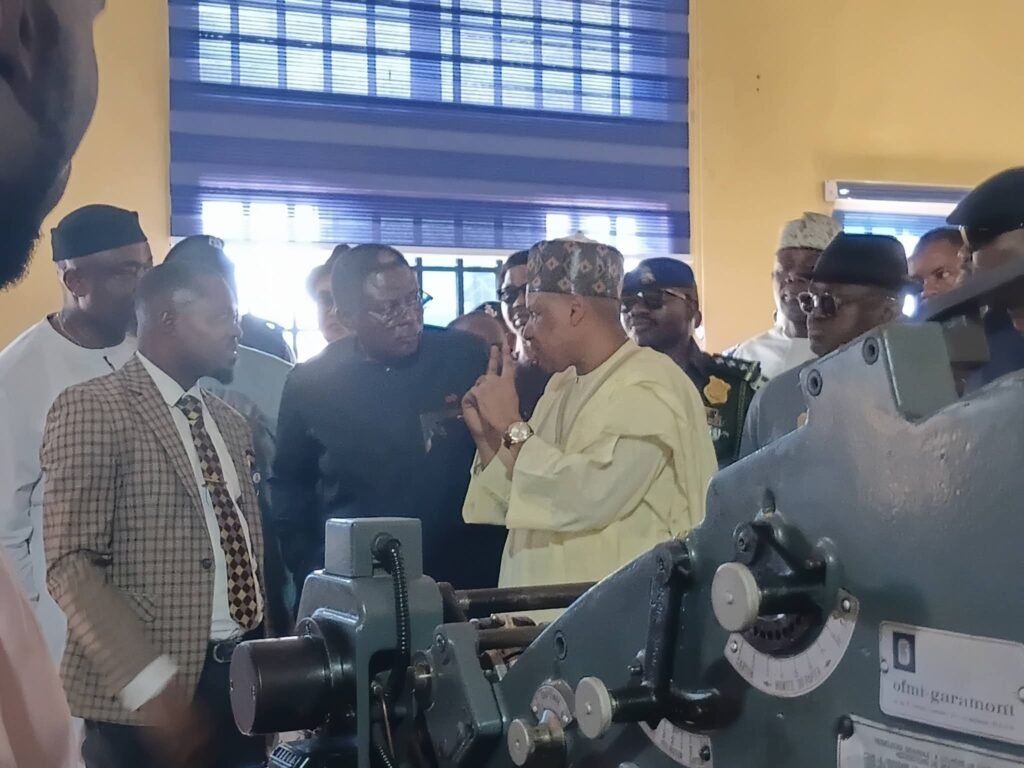
Cross River State Governor, Senator Bassey Edet Otu, has commissioned the state-owned newspaper publishing facilities of The Nigerian Chronicle in Calabar, marking the revival of the newspaper after about two decades of inactivity.
The commissioning ceremony was held on Thursday, September 3, 2026, at the newspaper’s premises on Barracks Road, Calabar.
Otu said the revival of The Nigerian Chronicle, established in 1974, was part of his administration’s commitment to strengthening information flow between government and citizens.
The governor recalled that during his first media parley after assuming office, he promised to revitalise the state’s information assets and strengthen the channels through which government communicates with the public.
He said the administration had fulfilled part of that commitment through the upgrading of transmission equipment at the Cross River Broadcasting Corporation (CRBC), as well as the renovation of its office facilities.
“Another most crucial information apparatus of the state is the ‘Nigerian Chronicle’ Newspaper established since 1974; but remained moribund for about two decades now,” Otu said.
He explained that the importance of the print media informed the decision to re-equip the newspaper’s facilities with modern printing equipment and renovate its entire complex.
According to him, the complex had suffered extensive damage and plundering during the #EndSARS protests of 2020.
Otu, however, challenged the management and staff of The Nigerian Chronicle to justify the state government’s investment by demonstrating commitment, hard work and professionalism.
He said the government’s responsibility did not end with the procurement and installation of modern printing machines and accessories, stressing that staff must also protect the facilities against vandalism.
The governor further tasked the newspaper’s editorial board with developing what he described as a Critical Response Initiative (CRI) in information management.
He said the initiative should enable the newspaper to keep the public informed about breaking developments while providing a response to misleading information and emergency situations within and outside Cross River State.
Otu urged the newspaper to maintain the professional standards expected of a conventional media organisation by verifying facts before publication.
“As a conventional media outlet, you should always verify facts before publication,” he said, adding that the newspaper must avoid falsehood and sensational reporting.
He also charged The Nigerian Chronicle to report the development milestones of his administration to enable members of the public to understand and assess the government’s activities.
The governor, however, cautioned the newspaper against treating every public perception as fact.
“Not all public perceptions are realities; so you need to sieve out propaganda from every happening within and outside the state,” he said.
Otu expressed hope that the revived newspaper would regain the confidence and interest of readers through accurate, responsible and credible reportage.

The revival of The Nigerian Chronicle comes alongside broader efforts by the Cross River State Government to reposition its information and communication infrastructure.
The governor said the objective was to ensure a stronger flow of information between the government and citizens while restoring the capacity of state-owned media institutions to fulfil their public information mandate.
The commissioning, therefore, represents a significant step in the state government’s effort to restore the newspaper’s operations and return its printing facilities to active use.
